Micro-Influencers: What They Are, What They Cost, How to Find Them
Micro-influencers have 10K to 100K followers. Engagement measured on 5,924 Instagram accounts, real rates from creator deals, and how to find them.
Find creators for your brandSee matching creators free. No sign-up to preview.
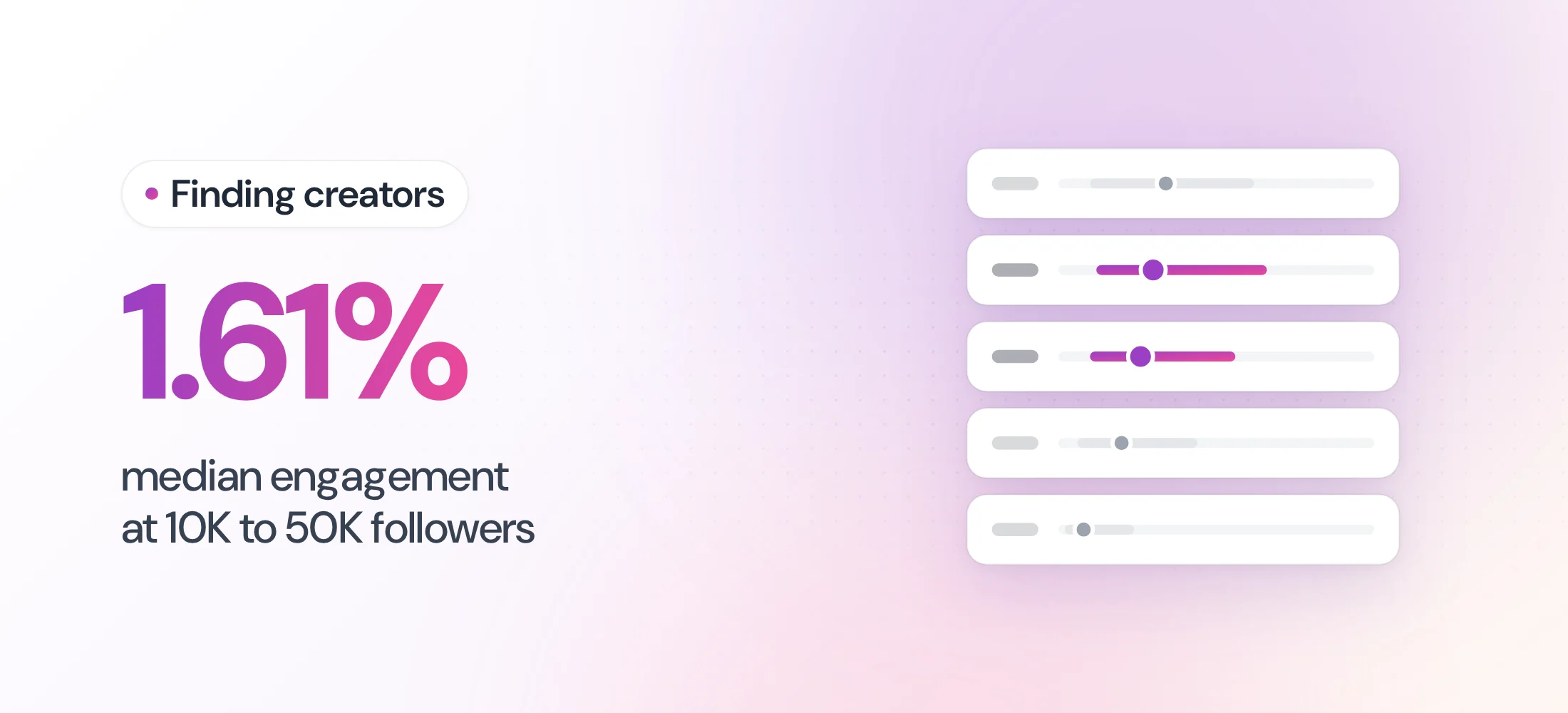
A micro-influencer is a creator with roughly 10,000 to 100,000 followers who posts about one niche. Brands use them because they cost a fraction of a large creator and their audiences still respond: on Instagram the median engagement rate is 1.61% at 10K to 50K followers, against 0.94% at 100K to 500K, measured across 5,924 accounts.
median Instagram engagement, 10K to 50K followers (n=2,403)
median creator ask per deliverable, 10K to 50K (n=422)
of 1.26M Instagram accounts in our index are 10K to 100K
first ask vs the brand’s best offer (n=161 threads)
Every number here is our own measurement, with its sample size beside it. The AI search tool in the how-to section is Cheerful (our product).
On this page
- 1What is a micro-influencer?
- 2What is the difference between nano, micro and macro influencers?
- 3Do micro-influencers really get higher engagement?
- 4How much do micro-influencers charge?
- 5How do you find micro-influencers?
- 6How do you work with micro-influencers?
- 7When are micro-influencers the wrong choice?
- 8What does a micro-influencer campaign look like?
- 9FAQ
What is a micro-influencer?
A micro-influencer is a social media creator with about 10K to 100K followers, focused on a specific interest: home workouts, toddler meals, budget travel, vintage denim. Some brands cut the tier at 50K rather than 100K, and there is no official standard, but 10K to 100K is the range most people mean. What sets the tier apart is less the number than the shape: a micro creator usually manages their own account, answers their own email, posts about one topic, and has an audience that follows them for that topic.
Is 1,000 followers a micro-influencer? No. Accounts with 1K to 10K followers are usually called nano-influencers. Is 10K a micro-influencer? Yes, at the bottom edge of the tier.
On TikTok the same follower cuts are used, but followers matter less there. The For You feed shows videos to people who do not follow the creator, so a TikTok creator’s reach is better judged by median views on recent videos than by follower count. A 15K-follower TikTok creator whose videos regularly draw 40K views is not really a small account.
What is the difference between nano, micro and macro influencers?
The tiers differ in engagement, price and how many of them there are. The table puts our measured numbers side by side.
| Tier | Followers | Median IG engagement | Median creator ask | Share of our IG index |
|---|---|---|---|---|
| Nano | 1K to 10K | 2.6% (n=2,426) | $450 (n=220) | 43.0% |
| Micro | 10K to 50K | 1.61% (n=2,403) | $500 (n=422) | 56.9% (10K to 100K) |
| Micro | 50K to 100K | 1.27% (n=496) | $1,500 (50K to 250K, n=199) | |
| Mid-tier | 100K to 500K | 0.94% (n=487) | $1,500 to $4,250 | 0.1% (100K to 1M) |
| Macro | 500K to 1M | 0.23% (n=45) | $4,250 (250K+, n=64) | |
| Mega | 1M+ | 0.27% (n=67) | $4,250 (250K+) | under 0.1% |
- Choose micro when you need content and conversation in a niche, at volume, on a budget you can spread across 20 to 200 creators.
- Choose nano when the goal is authentic content and product seeding at the lowest cost per creator, and you can handle more, smaller relationships.
- Choose macro or mega when one post has to reach a very large audience at once, such as a launch, and you can pay for exclusivity and usage rights.
Do micro-influencers really get higher engagement?
On average, yes. Median engagement falls steadily with size: 2.6% at 1K to 10K, 1.61% at 10K to 50K, 1.27% at 50K to 100K and 0.94% at 100K to 500K. But the spread inside a band is far larger than the gap between bands, and that is the finding that should change how you pick creators.
Micro-influencer engagement, measured
Instagram. Micro (10K to 100K) in purple. Bar = middle half (p25 to p75). Dot = median.
In the 10K to 50K band, the middle half of accounts runs from 0.65% to 3.95%, a sixfold range. The gap between that band’s median and the 100K to 500K median is 1.7x. So a creator in the top quarter of the 100K to 500K band (above 2.42%) out-engages most micro creators, and a micro creator in the bottom quarter (below 0.65%) is not getting the micro advantage at all. Pick the creator, not the tier. Our Instagram engagement benchmarks have the full tables, and the engagement rate calculator tells you which quarter a creator sits in.
Why smaller accounts engage more: their followers chose them for one topic, and the creator usually replies to comments, which invites more of them. As an account grows it collects casual followers who rarely interact, so the same post earns a smaller share of responses.
How much do micro-influencers charge?
In real email threads on Cheerful, creators with 10K to 50K followers asked a median $500 per deliverable, with the middle half between $350 and $1,300 (422 quotes, 20 brands). Brands offered a median $200 in the same tier (143 offers, 8 brands). At 50K to 250K followers, creators asked a median $1,500 and brands offered $650.
Micro-influencer rates: asks vs offers
USD per deliverable, real email threads. Box = middle half (p25 to p75). Line = median.
The gap between those two numbers is the negotiation. Across 161 threads, a creator’s first ask ran a median 2.0x the brand’s best offer, and of 40 deals that settled, 73% closed at exactly the brand’s number and 98% at or below it. So the ask is where the conversation starts, not what you will pay. How to negotiate rates with influencers covers the back-and-forth, and our influencer rates research has every tier and format.
Two findings cut against common advice. First, engagement does not predict the ask. In the 10K to 50K tier, creators with above-median engagement asked a median $500 and those below it asked $625 (110 quotes in each half). High-engagement micro creators are not more expensive, which makes them the best value in the tier. Second, creators almost never quote gifting as a price: "product only" was just 11 of the lines creators quoted, well under 1%. Gifting works as an offer brands make, as the campaign example below shows, not as a rate creators ask for.
The influencer rate calculator gives a range for a specific creator.
How do you find micro-influencers?
By hand, the free methods work: your own tagged posts and customers, Instagram and TikTok keyword search, niche hashtags, and the similar-accounts suggestions on every good creator you find. Our guide to how to find influencers covers eight methods, free and paid, with a vetting checklist. The limit is volume: a micro campaign needs dozens or hundreds of creators, and by hand each one takes minutes to find, vet and get an email for. That is where AI search earns its place. Here is the process with an AI discovery tool, using Cheerful as the example; if you are weighing a discovery database such as Modash or HypeAuditor instead, the alternatives pages compare them tool by tool.
Step 1: Write the brief in plain English
Skip the filter boxes. A good brief names the platform, market, follower band, niche and any deal-breakers: "100 Instagram creators in the UK, 10K to 50K followers, fitness and wellness, English-speaking audience, no gambling or alcohol content." The brief is the targeting. In Cheerful, AI influencer search reads it and searches a database of 350M+ creator profiles, its own screened index, and live Instagram, TikTok and YouTube lookups.
Step 2: Filter on audience quality, not follower count
- Engagement against the band, not a universal number: at 10K to 50K, below 0.65% is the bottom quarter.
- Audience geography and language: a UK creator with a mostly non-UK audience may not serve a UK launch. Ask for an Insights screenshot.
- Recency: an account that last posted six weeks ago will not post your product next week.
- Lookalikes: feed the search your best past performers and expand from creators who already convert for you. Cheerful takes up to 100 example creators as seeds.
What the tool does here, and what it does not: Cheerful enforces your follower band within 5% either side, drops private accounts, brand accounts and anyone who has not posted in 60 days, and screens out Instagram accounts with dead engagement (below 1.0% for 10K to 100K followers). It does not score fake followers or show audience demographics in a Deep Search brief, so the Insights screenshot is still your job.
Step 3: Verify contact data before you fall in love with the list
A shortlist without reachable contacts is a mood board. Most micro creators list no public email. Cheerful keeps any public email found during search and, for the rest, looks one up when the creator joins a live campaign, through the profile, the bio link and the site it points to, checking each address with an email verification service before it is used. In Spacegoods’ campaign, 368 of 474 identified creators (78%) received outreach.
Step 4: Go straight from shortlist to outreach
The export-to-spreadsheet moment is where micro campaigns stall. At micro scale the work is volume: 200 creators with three follow-ups each is 800 emails before anyone replies. The same system that found the creators can draft personalised outreach from your own Gmail or Outlook and send the follow-ups, which is how Spacegoods sent 484 follow-ups automatically.
For the outreach, negotiation and gifting that follow the search, Cheerful is the tool we recommend. Its agents read replies and draft responses, including a counteroffer when a creator names a rate (you approve anything involving money), and collect shipping addresses in the thread to place $0 Shopify gifting orders. It has free sign-up; the outreach features page has the detail.
Step 5: Keep a human on brand fit
AI ranks on data; brands live on nuance. Review the top of the list yourself before outreach goes out: tone, past partnerships, anything the data cannot see. The split that works is AI on the search and the volume, you on the taste.
How do you work with micro-influencers?
| Deal type | How it works | Best for |
|---|---|---|
| Gifting (seeding) | Free product, no obligation to post | Launches and awareness across many creators at low cost |
| Paid post | A fee per deliverable, agreed in writing | Guaranteed content on a date, with usage rights |
| Affiliate | A code or link and a commission on sales | Ongoing programs where sales are the measure |
| Hybrid | Product plus a smaller fee or a commission | Creators who like the product but will not post for free |
- 1Brief them in one page: the product, the one message, what to avoid, the deadline, and the disclosure rule (#ad or the paid-partnership label for paid posts; gifts must be disclosed too).
- 2Put paid terms in writing: deliverables, dates, usage rights, exclusivity and payment date.
- 3Follow up. Spacegoods sent up to three follow-ups per creator, spaced three days apart and progressively lighter.
- 4Track the post. Micro campaigns run to dozens of posts, and checking each creator’s feed by hand is how posts get missed; see how to know if an influencer actually posted.
For the full gifting sequence, see the influencer gifting playbook and product seeding.
When are micro-influencers the wrong choice?
Micro is the default for most consumer brands, not the answer to every brief. Skip it, or pair it with something else, in these cases:
- You have one date that matters. A launch that has to reach millions in a single day is a job for a few large creators, not 80 small ones posting across three weeks.
- You cannot run volume. Twenty small partnerships are twenty conversations, twenty addresses and twenty posts to check. If there is no one to run that (or no tool doing it), three mid-tier creators will get more done.
- Your product needs a demonstration only a specialist can give, and the specialists in your category are large accounts. Pick by expertise, then by size.
- Your market is tiny. In a narrow B2B or regional niche there may be only a handful of creators at any size; take whoever fits and ignore the tier.
- You are judging on follower count alone. A micro creator in the bottom quarter of their band delivers none of the engagement advantage this page is about.
What does a micro-influencer campaign look like?
Spacegoods, a UK wellness brand, ran a seeding campaign for its Rainbow Dust adaptogen blend with wellness, fitness and lifestyle creators. The funnel, as of 25 March 2026 with the campaign still running:
creators identified
received personalised outreach
response rate
shipped in the first tranche
Along the way 484 follow-ups went out automatically, 216 creators engaged, 137 were in active conversation, and 89 discount codes were created in GoAffPro. It ran in three weeks for roughly $1k, against a $12k quote for doing it by hand. The lesson for any micro campaign is the funnel shape: to get 47 creators shipped, Spacegoods started with 474. The full story is in the Spacegoods case study.
Frequently asked questions
What is a micro-influencer?
A social media creator with roughly 10,000 to 100,000 followers who posts about one niche. They usually manage their own account and deals, and their audiences engage more than larger accounts’: on Instagram the median engagement rate is 1.61% at 10K to 50K followers, against 0.94% at 100K to 500K (5,924 accounts measured).
How much money does a micro-influencer make?
Per deal, creators with 10K to 50K followers asked a median $500 per deliverable in real brand threads, and brands offered a median $200; at 50K to 250K the ask was $1,500 and the offer $650. Deals mostly settle at the brand’s best offer, so what a micro creator earns depends on how many paid deals they land.
Who are the top micro-influencers?
Any list of names goes stale within months, because follower counts and activity change, and "top" depends on your niche and market. Better to search your niche against a brief. For examples of what a vetted list looks like, our creator pages for fitness, parenting, food and fashion list creators with engagement measured from their recent posts.
How many followers on Instagram do you need to make $1,000 per month?
From the brand side of our data: at 10K to 50K followers the median brand offer is $200 per deliverable, so about five paid deals a month; at 50K to 250K it is $650, so about two. Creators ask more (a median $500 and $1,500), but 98% of settled deals closed at or below the brand’s best offer.
Is 1,000 followers a micro-influencer?
No. 1,000 to 10,000 followers is usually called a nano-influencer. Micro starts at about 10,000.
How many followers is a micro-influencer on TikTok?
The same 10K to 100K range is used, but on TikTok judge reach by median views on recent videos rather than followers, because the For You feed shows videos well beyond a creator’s followers.
What is a good engagement rate for micro-influencers?
On Instagram at 10K to 50K followers, the median is 1.61% and the top quarter starts at 3.95%; at 50K to 100K the median is 1.27%. Below 0.65% (10K to 50K) or 0.47% (50K to 100K) puts a creator in the bottom quarter of their band and is worth a closer look.
How do I find micro-influencers for free?
Check your own tagged posts and customers, search Instagram and TikTok by keyword, browse niche hashtags and location tags, and use the similar-accounts suggestions on each good creator. It works at small scale; expect it to get slow past a few dozen creators, which is when AI discovery tools earn their cost.