To find influencers for your brand, start with people who already know you (customers, followers, anyone who tags you), then search Instagram and TikTok by keyword, hashtag and location, and look at who your competitors already work with. When you need more than a few dozen creators, add a creator marketplace or an influencer database. Whichever route you take, check every creator’s engagement against the norm for their follower band before you reach out.
The free methods work, and they come first below. What limits them is hours, not money: somewhere around 30 to 50 creators, the time it takes to find, vet and get an email for each one becomes the real cost. Each method is laid out with steps, what it costs and where it breaks, followed by the vetting checklist we use, built on engagement benchmarks we measured across 5,924 Instagram accounts.
Disclosure: we make Cheerful, one of the AI search tools in method 7. Where it appears, we say what it checks and what it does not.
What should you decide before you search for influencers?
Write a one-line creator brief first. Every method below filters on some of the same five things, and without a brief you end up judging each profile on vibes. The five fields: who their audience is, what they post about, how many followers they have, where they (and their audience) live, and which platform.
“US Instagram creators with 10K to 50K followers who cook quick weeknight dinners for families. Audience mostly in the US. No alcohol content, and nobody who posted for a meal-kit brand in the last 90 days.”
Then decide how many creators you need to find, which is always more than the number you want posting. In Spacegoods’ seeding campaign, 474 creators were identified, 368 were pitched, 216 engaged and 47 had shipped in the first tranche. Plan on finding roughly ten creators for every one you want to ship to, and pick your method by whether it can produce that many.
If you are unsure which follower band to brief, our micro-influencer guide compares tiers on measured engagement and what creators actually charge.
What are the best ways to find influencers?
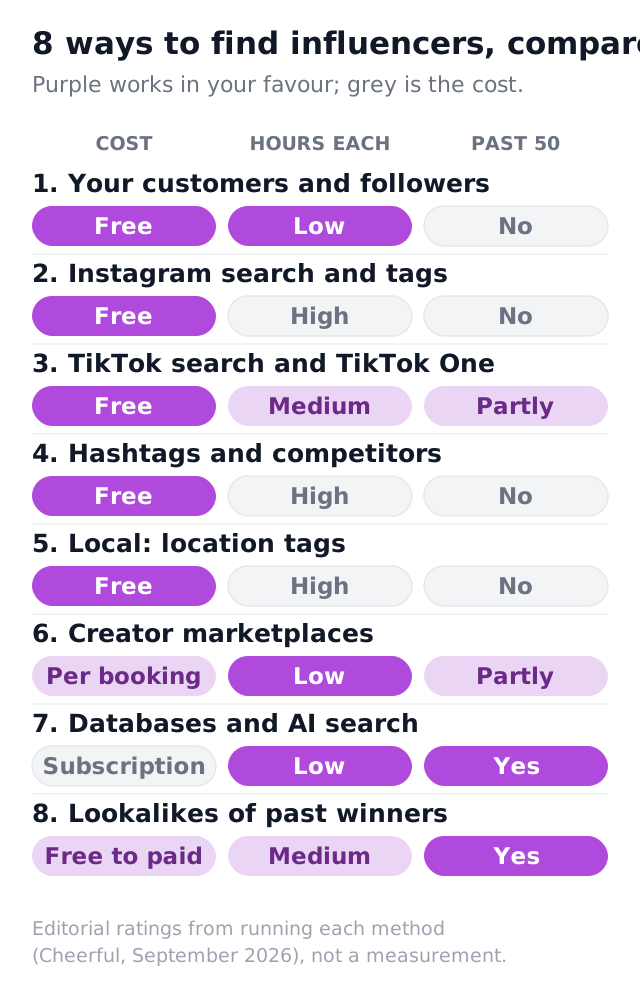
Here are the eight methods, ordered roughly from cheapest to most scalable. The ratings in the chart are ours, from running each one, not a measurement: purple marks where a method works in your favour, grey marks its cost.
1. Your own customers and followers
The creators with the best fit are often already buying from you. They need no convincing about the product, their content reads as genuine because it is, and a lot of them will post in exchange for product alone.
- 1Open the Tagged tab on your Instagram profile and your mentions on TikTok. Anyone with a real audience who tagged you unprompted goes on the list.
- 2Scroll your own followers for professional accounts. Creator and business accounts can show a category label (Digital creator, Blogger, Chef) under their name.
- 3Add one question to your post-purchase email or survey: "Do you create content? Leave your handle." It costs nothing and keeps producing names.
- 4Search your customer list for the creators you already know about. A creator who has ordered twice is a warmer pitch than any stranger.
Where it breaks: it only finds people who already know you, so a new brand runs out fast. Story mentions also vanish after 24 hours. If you connect Instagram to Cheerful, mentions, photo tags and story mentions of your brand are captured as they happen, so this list builds itself.
2. Instagram search and tagged posts
Instagram search takes keywords, not just handles and hashtags. Search the thing your customer cares about ("weeknight dinner", "postpartum fitness", "capsule wardrobe"), open the accounts tab, and work through the results.
- 1Search three to five keywords from your brief and open every account that looks like a person rather than a brand or a repost page.
- 2On each good creator’s profile, tap the arrow next to Follow. Instagram shows similar accounts, and this is usually the richest seam on the platform.
- 3Check their Tagged tab to see which brands they already post about, and whether one is a direct competitor.
- 4Note the follower count, the last post date and a rough engagement rate. The Instagram engagement rate calculator does the arithmetic.
Where it breaks: you see only what is on the profile. There is no filter for audience location or follower band, most creators list no email, and each vetted creator takes minutes of scrolling. That is fine for 20 creators and slow for 200.
3. TikTok search and TikTok One (the Creator Marketplace)
TikTok search works like Instagram’s: search a topic, switch to the Users tab, and open profiles. On TikTok, look at views before followers. The For You feed shows videos to people who do not follow the creator, so a 20K-follower account can outperform a 200K one, and a large account whose recent videos draw a few hundred views has an audience that is no longer watching.
TikTok also runs its own marketplace, the Creator Marketplace, now part of TikTok One, where creators who opted in to brand deals can be searched with performance data from TikTok itself rather than a scrape. The catch is supply: you see only creators who signed up, not everyone posting in your niche.
4. Hashtags and your competitors’ partnerships
Hashtags still work if you use niche ones. A broad tag like #fitness is dominated by brands, repost pages and huge accounts; a specific one (#hybridtraining, #postpartumfitness, #mealprepsunday) is mostly creators. Look at recent posts, not top posts, because top posts skew toward accounts that are already big.
Competitors are the other shortcut. Open a competitor’s Tagged tab and look for posts labelled "Paid partnership" with them. Those creators have already shown they will post about your category. Before you pitch, check dates: a creator who posted for a direct competitor in the last 90 days may be under exclusivity, and their audience has just seen the pitch from someone else.
5. Local influencers: how do you find influencers in your area?
For a restaurant, gym, salon or anything with a physical location, local reach matters more than size. Four ways to find local creators:
- Search a place on Instagram (your neighbourhood, a landmark, a popular venue nearby) and browse the posts tagged there. Creators who tag locations near you live or spend time there.
- Search keyword plus city on Instagram and TikTok: "austin brunch", "leeds hair", "denver hikes".
- Google the city with your niche and "blogger" or "instagram" to catch local food, parenting and lifestyle creators with their own sites.
- Look at who is tagged by local businesses your customers already use, and at who covers local events.
Where a creator lives and where their audience lives are different questions. A creator based in Chicago can have most of their audience elsewhere. Only the creator’s own Instagram Insights show audience location, so ask for a screenshot before you commit budget.
6. Marketplaces where creators apply to you
Creator marketplaces flip the search: creators list themselves with packages and prices, and you browse or post a brief and let them apply. Collabstr is the example Google’s own answer names for this query. Marketplaces are fast, and the price is visible up front, which saves a round of negotiation.
Two limits. Supply is only the creators who chose to list, which skews toward people actively selling sponsored posts rather than the fan who would post for product. And listing does not mean vetted: the checks in the vetting section below still apply to every applicant.
7. Influencer databases and AI search tools
An influencer database indexes public creator profiles so you can filter by platform, niche, follower count, location and engagement instead of scrolling. This is the "influencer search tool" category, and it is where the free methods get replaced once volume matters. They differ in what you search with and what they leave to you.
| Tool | Type | How you search | Left to you |
|---|---|---|---|
| Modash | Discovery database | Filters over a large creator index, audience filters | Replies and the rate conversation |
| Heepsy | Budget discovery database | Filters by niche, location and size | Everything after the shortlist |
| HypeAuditor | Audit and analytics platform | Database search plus audience-quality reports | Most of the campaign work |
| Upfluence | All-in-one platform | Database search plus an AI agent | Rate negotiation |
| TikTok One | Native marketplace | TikTok creators who opted in | Every other platform |
| Cheerful (ours) | AI search from a written brief | Plain-English brief, lookalike seeds, live lookups | Taste: the final yes or no |
Here is how the tool does this step in Cheerful. You type the brief from the first section in plain English. Deep Search draws on a third-party database of 350M+ creator profiles, Cheerful’s own screened index, live Instagram, TikTok and YouTube lookups, and web and hashtag search. Before a creator reaches you it drops private accounts, brand and business accounts, repost pages and anyone outside your follower range (enforced within 5% either side), and an AI judge reads each candidate’s posts against your brief. The first deck of about 20 creators arrives within a minute; you keep or pass on each one, and the full run of up to 200 takes 15 to 60 minutes. AI influencer search has the details, and where Cheerful finds creators lists every source and check.
Where it breaks: every database is a snapshot, and follower counts, bios and activity go stale. Prefer tools that re-check a profile live before showing it. And a database cannot tell you whether a creator will actually like your product, which is why the brief and the final review stay with you.
8. Lookalikes of creators who already worked
Once a few creators have posted for you and it went well, they are your best search query. Creators who resemble them in niche, audience and format tend to perform similarly, and this is the method that keeps improving the longer you run a program.
- By hand: open each winner’s profile, tap the arrow next to Follow for similar accounts, look at who they follow and tag, and look at which creators leave real comments on their posts.
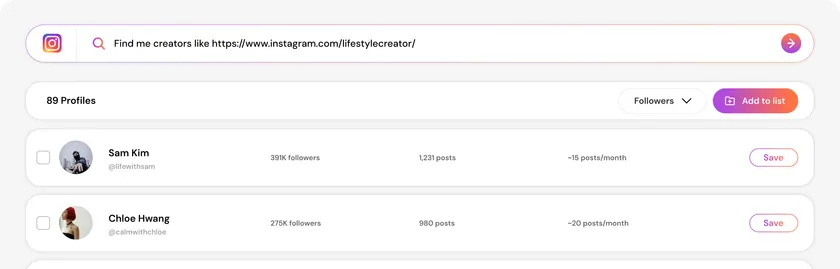
- In a tool: give it the winners as seeds. In Cheerful you can add up to 100 example creators to a brief, or run a direct "similar to @handle" search.
- Seed on what made them work. Five creators who share a niche and a format make a better seed than five who share a follower count.
Is there a free way to find influencers, and when does it stop scaling?
Yes. Methods 1 to 5 cost nothing but time, and TikTok One and most marketplaces are free to browse. The question is how many hours you have. Run the arithmetic on your own pace: if finding, checking and locating an email for one creator takes you 15 minutes, a list of 50 is 12.5 hours, and a list of 400 (what a 40-creator seeding campaign needs, by the ten-to-one rule above) is 100 hours.
Reply rates make it steeper. In AG1’s affiliate recruiting program, about 12% of 20,521 contacted creators replied. A warm, personalised gifting pitch does far better (Spacegoods saw 58.7%), but even then you are finding two creators for every one who answers.
- Under 30 creators, one-off campaign: free methods 1 to 5. A spreadsheet is enough.
- Local business in one city: method 5 plus method 1. Location matters more than size.
- You want to buy posts at a known price, fast: a marketplace (method 6).
- 50+ creators a month, or a recurring program: a database or AI search tool (method 7), with lookalikes (method 8).
- You need audience demographics before you commit: ask for Insights screenshots, or use an audit tool.
How do you vet an influencer before you reach out?
Vetting takes a few minutes per creator and saves the whole cost of a bad partnership. Check four things: is engagement normal for their size, is the audience real, is it in the right place, and is the content safe to sit next to your brand.
Is their engagement rate normal for their follower band?
Engagement rate is (average likes + average comments) on recent posts, divided by followers. It falls as accounts grow, so a single "good engagement rate" is meaningless. Compare each creator to their own band. These are the bands we measured across 5,924 Instagram accounts between 17 August and 6 September 2026, excluding accounts that hide their likes:
| Follower band | Accounts (n) | 25th percentile | Median | 75th percentile |
|---|---|---|---|---|
| 1K to 10K | 2,426 | 1.12% | 2.6% | 5.6% |
| 10K to 50K | 2,403 | 0.65% | 1.61% | 3.95% |
| 50K to 100K | 496 | 0.47% | 1.27% | 3.29% |
| 100K to 500K | 487 | 0.28% | 0.94% | 2.42% |
| 500K to 1M | 45 | 0.09% | 0.23% | 1.2% |
| 1M+ | 67 | 0.12% | 0.27% | 0.57% |
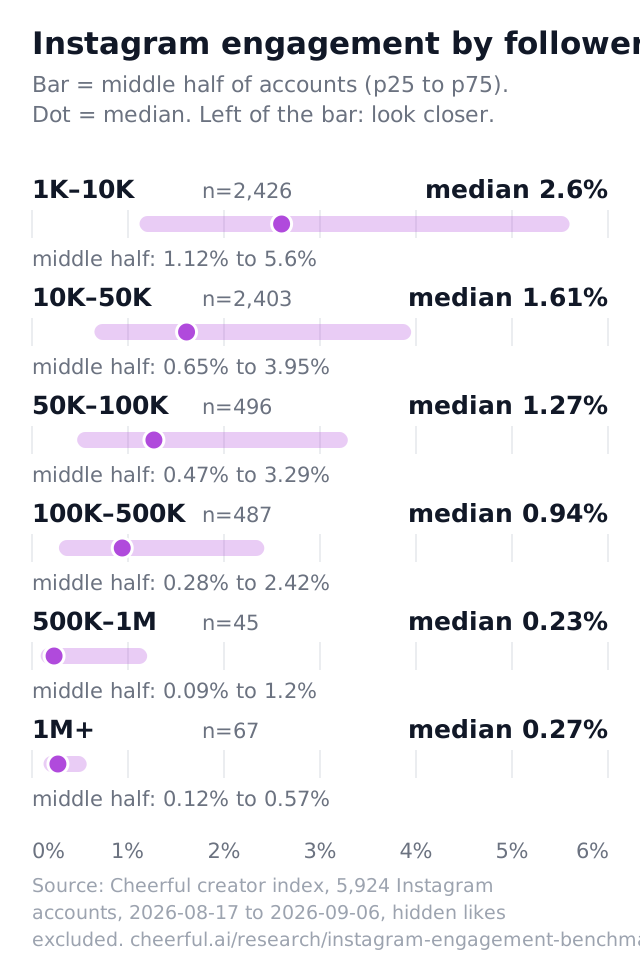
The decision rule: below the band’s 25th percentile, look closer before you pitch. That does not mean reject, because a creator can have an off month or a niche with quiet audiences. It does mean the follower count is overstating reach. Two worked examples:
- A 30,000-follower creator averaging 240 likes and 12 comments: 252 ÷ 30,000 = 0.84%. That is above the 10K to 50K floor of 0.65% and below the 1.61% median. Normal. Pitch them.
- A 142,002-follower cooking account from our food creators research, with a median of 80 likes and comments per post: about 0.06%, against a 100K to 500K floor of 0.28%. That is roughly one response per 1,775 followers, and the follower count is not usable as a reach estimate.
Engagement far above the band’s 75th percentile also deserves a look, especially on a large account, because bought likes and engagement groups inflate it. The full tables, by band and by Instagram category, are in our Instagram engagement benchmarks. For TikTok, compare median views on recent videos with follower count using the TikTok engagement rate calculator.
How can you tell if an influencer has fake followers?
No outside check can prove an audience is real, but the signs are consistent. Look for several of these together, not one alone:
- Engagement far below the band floor above, on every recent post rather than one.
- Comments that could sit under any post: single emojis, "Nice pic!", the same phrases repeated, or accounts with no posts and no profile photo.
- A follower jump of thousands in a day or two with no viral post to explain it. Ask for a growth screenshot if you cannot see one.
- On TikTok and Reels, views that are a tiny fraction of followers on every video.
- An audience concentrated in countries that make no sense for the creator’s language and content.
What Cheerful checks, and what it does not. During Deep Search, Cheerful drops accounts that are private, have fewer than five posts, have not posted in 60 days (120 on YouTube), or show dead engagement for their size. On Instagram, for creators with 10K or more followers, the floor is a 1.0% median engagement rate over their last 12 posts below 100K followers, 0.6% from 100K and 0.4% from 500K. Accounts that hide likes are judged on comments instead, and TikTok creators whose videos draw too few views for their follower count are removed. What it does not have is a fake-follower score or an audit of who the followers are. Engagement is used to screen out dead accounts, not to certify live ones. If an audience-authenticity score is a hard requirement, audit tools such as HypeAuditor sell one; either way, ask the creator for an Insights screenshot.
Audience location, brand safety and past partnerships
Instagram’s professional dashboard shows a creator their audience’s top countries, cities, age range and gender. Only they can see it, so ask for a screenshot as part of your first reply. Creators who work with brands send these routinely, and one who will not is telling you something. Then scroll six months of their posts and captions for anything you would not want next to your brand, and look at their paid partnerships: some disclosed sponsored posts are a good sign; undisclosed ads are a compliance risk for you, not just for them.
Influencer vetting checklist (spreadsheet)CSV, opens in Google Sheets or Excel · free, no email requiredFourteen checks with how to run each one, the pass rule and the "look closer" rule, plus columns to score three creators side by side.Where do you find influencers on Instagram, TikTok and YouTube?
On Instagram, use keyword search, the similar-accounts arrow on good profiles, the Tagged tab of your brand and your competitors, and location pages. Instagram is where the most micro creators are: in our index of 1,259,458 Instagram accounts with 1,000+ followers, 57% sit between 10K and 100K followers. Most list no email, so budget time for DMs or an email lookup.
On TikTok, use topic search on the Users tab, sounds and hashtags in your niche, and TikTok One for creators who opted in to brand deals. Judge on views, not followers.
On YouTube, search your topic, filter to recent uploads, and look at who is making videos your customer would watch before buying: reviews, comparisons, tutorials. Channels often list a business email on their About page. Judge on views per video against subscribers, and YouTube also runs its own brand-deal program, BrandConnect, where it is available.
If you want to see what a vetted list looks like before you build one, our creator pages for fitness, parenting, food and fashion list real creators with engagement measured from their recent posts.
How do you hire an influencer once you’ve found them?
- 1Send a short, personal first message by email where you can: what you liked about a specific post, what you are offering, and one clear next step. Follow up two or three times, a few days apart (Spacegoods sent up to three follow-ups, three days apart). Our response-rate data covers what moves the reply rate, and the wording is in our 10 influencer outreach templates.
- 2Agree the deal: deliverables, dates, usage rights and price. Expect the first ask to be about twice what you will end up paying. Across 161 real threads, the creator’s first ask ran a median 2.0x the brand’s best offer, and 73% of 40 settled deals closed at exactly the brand’s number. How to negotiate rates walks through it.
- 3Put it in writing, send the product or brief, and track whether the post goes live. Checking whether an influencer actually posted covers the last step.
What are the most common mistakes when finding influencers?
- Searching before writing the brief. You end up with a list of creators you like, not creators your customer follows.
- Judging on follower count. A 30K creator in the top quarter of their band (3.95%+) gets more likes and comments per post than a 150K account in the bottom quarter of its band (under 0.28%).
- Using one engagement cut-off for every size. 1% is bottom-quarter at 5K followers and above the median at 300K.
- Building a list the size of the result you want. Plan on about ten found for every one who posts.
- Trusting a database snapshot. Check the last post date and current follower count before you pitch.
- Skipping the audience screenshot. A creator’s location is not their audience’s location.
- Pitching a creator who just posted for your competitor.
Frequently asked questions
- How do I find an influencer in my area?
- Search your neighbourhood or a nearby landmark on Instagram and browse the posts tagged there, search keyword plus city on Instagram and TikTok ("austin brunch"), Google your city with your niche and "blogger", and look at who local businesses tag. Then ask each creator for an Insights screenshot, because a local creator can still have a mostly non-local audience.
- How do I hire an influencer?
- Find and vet them, send a short personal email that names a specific post and a clear offer, follow up two or three times, then agree deliverables, dates, usage rights and price in writing. Expect the first ask to be about twice your final price: across 161 real threads the median first ask was 2.0x the brand’s best offer.
- What is the average cost of an influencer?
- It depends on size far more than on anything else. In real brand and creator threads measured in September 2026, creators with 10K to 50K followers asked a median $500 per deliverable and brands offered a median $200; at 50K to 250K the ask was $1,500. Full tables are on our influencer rates research page.
- What is the best website to find influencers?
- It depends on the job. For free, Instagram and TikTok’s own search, with TikTok One for creators who opted in to brand deals. For buying posts at a listed price, a marketplace such as Collabstr. For volume, an influencer database or an AI search tool; Cheerful, which we make, searches 350M+ profiles plus live lookups from a plain-English brief.
- Is there a free way to find influencers?
- Yes: your own tagged posts and customers, Instagram and TikTok keyword search, niche hashtags, competitors’ paid partnerships and location tags all cost nothing but time. They stop scaling at around 30 to 50 creators, when the hours per vetted creator become the real cost.
- What’s the best way to find influencers?
- Start with people who already tag or buy from you, then search Instagram and TikTok by keyword and use the similar-accounts suggestions on every good creator you find. Once you have a few creators who performed, find lookalikes of them. Vet every creator’s engagement against their follower band before reaching out.
- Where can I see influencers?
- On the platforms themselves: Instagram and TikTok search, hashtag and location pages, and the Tagged tabs of brands in your category. Curated lists help you see what good looks like; our creator pages for fitness, parenting, food and fashion list creators with engagement measured from their recent posts.
- Is there a database specifically for finding influencers?
- Yes. Influencer databases index public creator profiles so you can filter by platform, niche, follower count, location and engagement. Modash, Heepsy, HypeAuditor and Upfluence all sell one. Cheerful draws on a third-party database of 350M+ profiles plus its own screened index, and re-checks each creator live before showing them.
- How do you check if an influencer has fake followers?
- Compare engagement with their follower band (on Instagram at 10K to 50K followers, below 0.65% is the bottom quarter), read 20 comments for generic or bot-like replies, look for unexplained overnight follower jumps, check that video views keep pace with followers, and ask for an Insights screenshot of audience location. Cheerful screens out dead-engagement accounts but does not produce a fake-follower score.
- How do I find influencers on TikTok?
- Search your topic and switch to the Users tab, follow niche sounds and hashtags, and use TikTok One (the Creator Marketplace) for creators who opted in to brand deals. Judge creators on median views across recent videos rather than follower count, because the For You feed reaches beyond followers.