Influencer Marketing Strategy: A 12-Step Plan (With Template)
·20 min read·By Abubakr Chan
An influencer marketing strategy is a written plan for which creators you work with, what you pay them, what they make, and how you will know it worked. A plan that works has 12 steps in four phases: set goals and KPIs, define the audience, pick creator tiers and set a budget; then find, vet, contact, negotiate with and contract creators; then brief, ship, approve and amplify the content; and finally track results and decide who to book again.
This guide gives each step three things: the decision to write down, the tool you would use for it (a spreadsheet or a platform, with an honest threshold for when you need the second), and a real number from campaigns run on Cheerful where we have one. Cheerful is our product, so read the tool mentions with that in mind; every step also works without it.
Influencer marketing plan templateExcel / Google Sheets (.xlsx) · free, no email requiredEight tabs: the 12-step plan, a budget with formulas, a creator shortlist that flags weak engagement, an outreach log, a tracker, an auto-calculated report, and our rate and engagement benchmarks.What is an influencer marketing strategy?
Strategy and plan get used interchangeably. The useful distinction: the strategy is the few choices that shape everything else (the goal, the audience, the creator tier, how you pay), and the plan is the list of steps and dates that carries them out. You need both, and they fit on one page each.
The first choice is the type of program, because it changes the budget, the contract and what you can measure:
| Program | What the creator gets | Best for | Watch out for |
|---|---|---|---|
| Gifting (seeding) | Product, no fee, no obligation to post | Awareness and content volume on a small budget | Many creators will not post; plan for it |
| Paid posts | A flat fee per deliverable, plus product | Guaranteed content on a date | Price varies widely for the same follower count |
| Affiliate | A commission on sales through a code or link | Sales, at low risk to you | Established creators often decline commission-only |
| Ambassador | A monthly fee over several months | Repeat exposure and a trusted face | Needs a longer contract and exclusivity terms |
Most programs mix two of these. A common shape is gifting to many small creators to find the ones whose audience responds, then paying the best of them for posts. That is the shape of the worked example below.
The 12-step influencer marketing plan at a glance
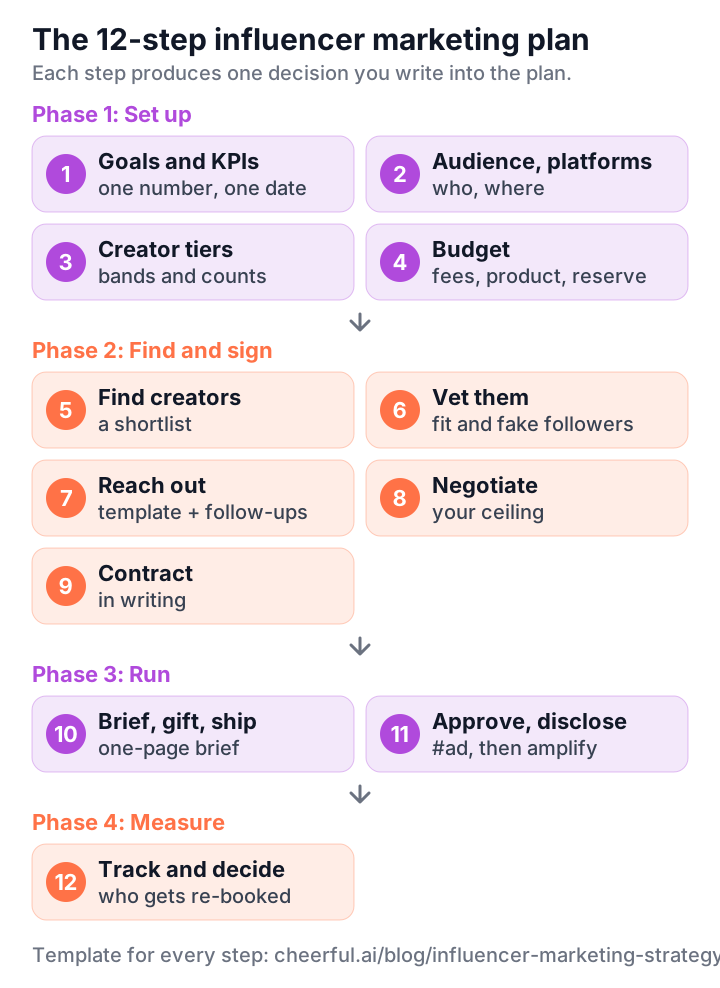
| Step | What you decide | Output | Tool |
|---|---|---|---|
| 1. Goals and KPIs | One goal, one number, one date | A KPI line | The plan doc |
| 2. Audience and platforms | Who buys and where they watch | One or two platforms | Your analytics |
| 3. Creator tiers | Follower bands and how many | A tier mix | Benchmarks |
| 4. Budget | Fees, product, shipping, reserve | A budget table | Spreadsheet |
| 5. Find creators | Where the shortlist comes from | A shortlist | Platform search or a discovery tool |
| 6. Vet creators | Fit rules and red flags | A vetted list | Engagement benchmarks |
| 7. Reach out | Channel, message, follow-ups | Replies | Your inbox or an outreach tool |
| 8. Negotiate | Your ceiling per tier | Agreed terms | Rate data |
| 9. Contract | Which agreement | Signed agreements | A template plus e-signature |
| 10. Brief, gift and ship | What to make; how product gets there | Briefs and shipped orders | Your store |
| 11. Approve, disclose, amplify | Review rounds, disclosure, ads | Live, compliant posts | Platform ad tools |
| 12. Track and decide | What counts, who gets re-booked | A report | Codes, UTMs, post tracking |
Phase 1: Set up the plan
Four decisions, made before you contact anyone. Skip them and a campaign ends with a folder of posts and no answer to "did it work?".
1. Set goals and KPIs
Pick one primary goal and write the KPI as a number with a date: "120 orders on creator codes within 60 days of the first post", not "drive sales". A KPI (key performance indicator) is the single measure that tells you whether the goal was hit. Secondary goals are fine only if you will actually measure them.
| Goal | KPI | How it is measured | Healthy sign |
|---|---|---|---|
| Awareness | Views or reach; CPM (cost per 1,000 views) | Creator insights at 7 and 30 days | CPM at or below what you pay for paid social |
| Engagement | Engagement rate; CPE (cost per engagement) | Likes, comments, shares and saves ÷ views or followers | Comments that mention the product, not just emojis |
| Sales | Orders and revenue on codes and links; cost per order; ROAS | Unique discount codes, UTM-tagged links, your store | Cost per order under your target acquisition cost |
| Content | Usable assets; cost per asset | Count of posts you have the rights to reuse | Assets you actually reuse in ads or email |
| Recruiting affiliates | Opt-ins; active affiliates | Sign-ups to your affiliate program | Opt-ins who go on to post |
The tracking has to be set up now, not after the posts go live: a unique discount code and a UTM-tagged link per creator, and a note of how you will capture views. Codes undercount (plenty of buyers never type one), so treat code revenue as a floor, not the total. The full measurement method is in how to measure influencer marketing ROI.
2. Define your audience and platforms
Write down who buys (age, country, language, what they care about) and where they spend time watching. Your own customer data beats assumptions: look at your store’s top countries, your Instagram and TikTok follower insights, and what your best customers already follow.
- Instagram: Reels and Stories, strong for lifestyle, beauty, food and wellness, and the easiest place to reuse content through Partnership Ads.
- TikTok: fastest reach from small accounts, because distribution depends less on follower count; Spark Ads let you boost creator videos.
- YouTube: slower and pricier per video, but a video keeps being found through search for months, which suits considered purchases.
Pick one platform to start, two at most. Country matters as much as platform: a creator with 80% of their audience outside your shipping area is a poor buy at any price.
3. Choose creator tiers
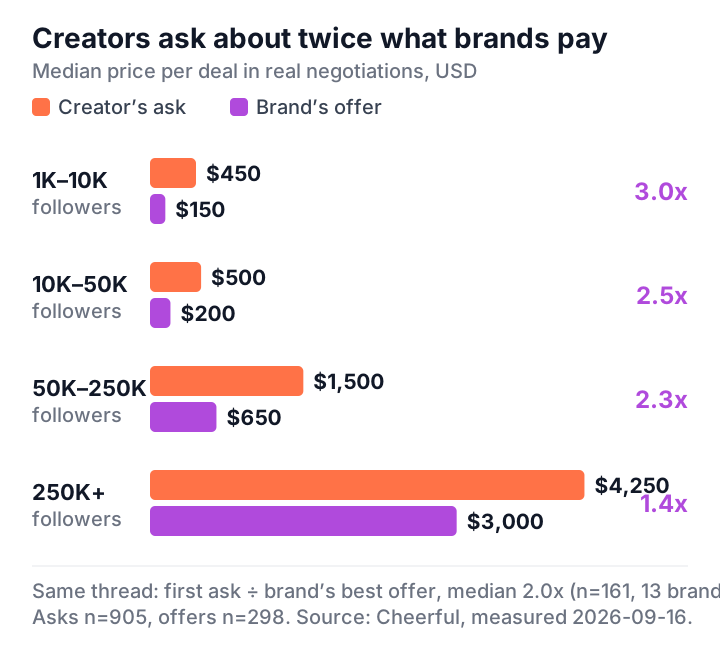
Tiers are follower bands. Engagement falls as accounts grow and prices rise, so the tier mix sets both your reach and your cost. These are the medians from our own data: engagement from 5,924 Instagram accounts measured 17 August to 6 September 2026, and prices from real brand and creator email threads on Cheerful, measured 16 September 2026.
| Tier | Followers | Median IG engagement | Median creator ask | Median brand offer |
|---|---|---|---|---|
| Nano | 1K–10K | 2.6% (n=2,426) | $450 (n=220) | $150 (n=82) |
| Micro | 10K–50K | 1.61% (n=2,403) | $500 (n=422) | $200 (n=143) |
| Mid-tier | 50K–250K | 1.27% at 50K–100K; 0.94% at 100K–500K | $1,500 (n=199) | $650 (n=44) |
| Macro and up | 250K+ | 0.94% at 100K–500K; 0.23% at 500K–1M; 0.27% at 1M+ | $4,250 (n=64) | $3,000 (n=29) |
The engagement bands and price tiers were cut at different follower counts, so the mid-tier and macro rows show the bands that overlap them. The decision rule that falls out: for a first campaign, put most of the creator count in nano and micro, where engagement is highest and a gifting or low-fee offer is realistic, and add a few mid-tier creators only if reach is the goal. Our Instagram index is itself mostly this size: of 1,259,458 accounts with at least 1,000 followers, 57% have 10K to 100K.
4. Set a budget
Budget from the price data, not from hope. The single most useful number: across 161 negotiations on Cheerful (13 brands), a creator’s first ask was a median 2.0x the brand’s best offer on the same thread. If you budget at creators’ opening prices, you will overspend; if you budget at the lowest offers, you will be turned down a lot.
Two worked budgets, built the way the template’s Budget tab does it. Fees are set between the median offer and the median ask for each tier ($350 for 10K–50K, $1,000 for 50K–250K). Product is counted at your cost ($25 assumed), shipping at $10 a parcel, and the last line covers software, e-signature and a reserve for re-shoots.
| Line | $5,000 program | $20,000 program |
|---|---|---|
| Paid creators, 10K–50K | 8 × $350 = $2,800 | 20 × $350 = $7,000 |
| Paid creators, 50K–250K | none | 4 × $1,000 = $4,000 |
| Product for paid creators | 8 × $25 = $200 | 24 × $25 = $600 |
| Gifting-only creators (product) | 40 × $25 = $1,000 | 100 × $25 = $2,500 |
| Shipping | 48 × $10 = $480 | 124 × $10 = $1,240 |
| Ad spend to boost the best posts | none | $3,000 |
| Tools and reserve | $520 | $1,660 |
| Total | $5,000 (48 creators) | $20,000 (124 creators) |
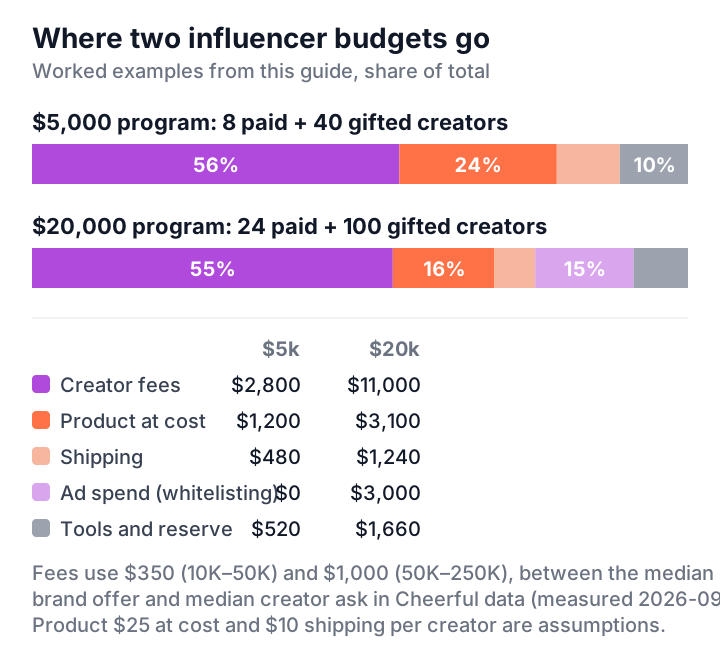
Creator fees end up a little over half of both budgets. Product and shipping are the lines people forget, and on the gifting-heavy $5,000 plan they are a third of the spend. To test your own numbers per creator, the influencer rate calculator and the full influencer rates 2026 tables use the same data.
Phase 2: Find and sign creators
This phase is where the hours go, and it is where a tool changes the plan most. Each step below says what a spreadsheet and an inbox can handle and where they stop.
5. Find influencers
There are four sources, and good shortlists use more than one: platform search and hashtags; your own followers and customers who already post about you; lookalikes of creators who worked before; and discovery tools that search a database of creator profiles by niche, location and size. Aim for a shortlist about three times the number of creators you need, because vetting and outreach both cut it down.
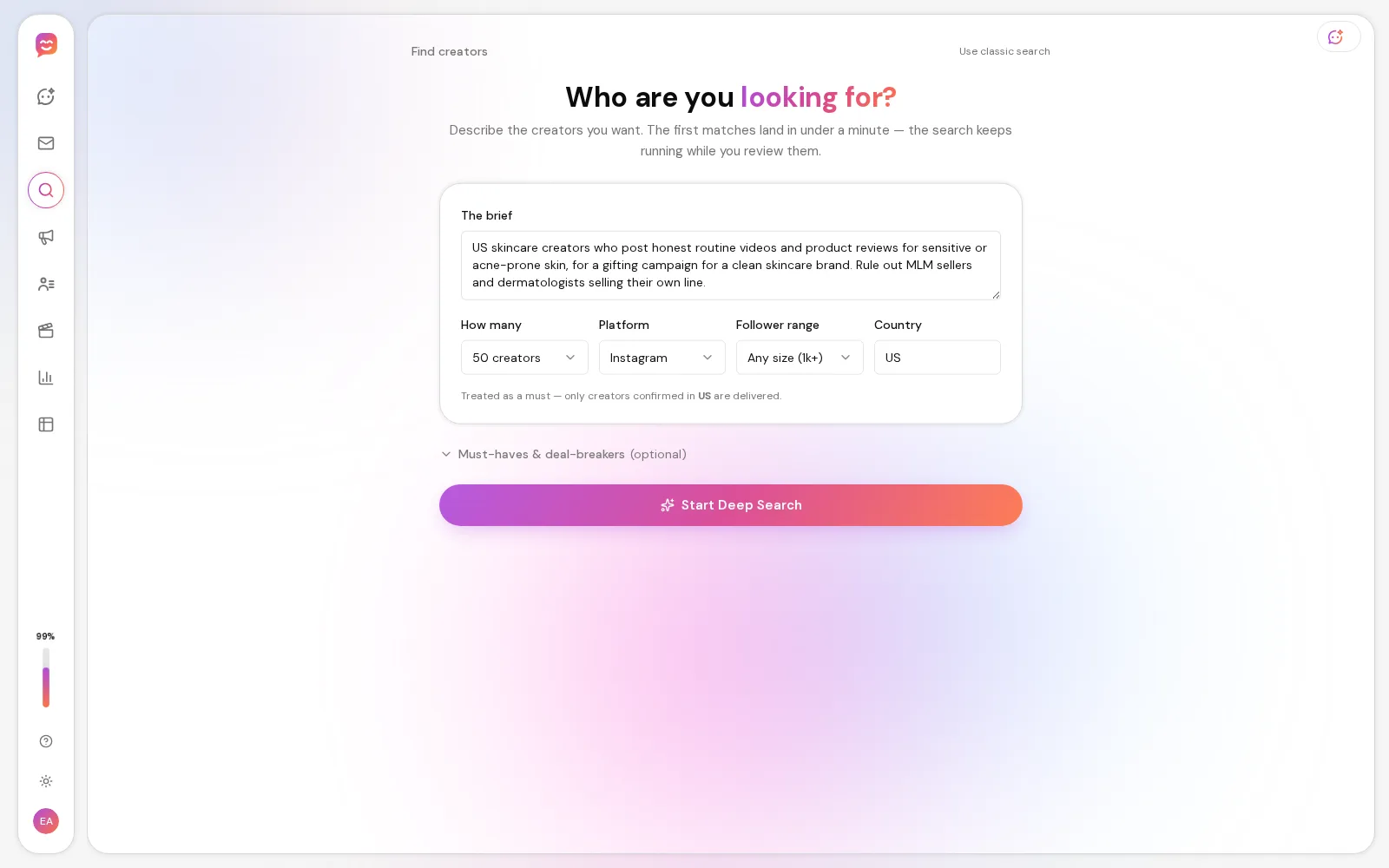
By hand, this means searching hashtags in the app and pasting handles into the Shortlist tab of the template. That works for 20 or 30 creators. Past that, a discovery tool does the filtering. In Cheerful, for example, you describe the creators you want in plain English, and it searches a database of 350M+ profiles plus live Instagram, TikTok and YouTube lookups, then checks each candidate against your follower range, location and topic before it reaches you. The full method comparison is in how to find influencers.
6. Vet creators for fit and fake followers
Vetting answers two questions: would this creator’s audience buy from you, and is the audience real? Fit comes first. Read their last 12 posts: do they post in your niche, do they already mention products like yours, and do comments read like real people talking to them?
For the second question, compare their engagement with accounts of the same size. Our rule: engagement below the 25th percentile for the follower band gets a closer look. It is not an automatic rejection (some good accounts post rarely or hide likes), but it is where bought followers show up.
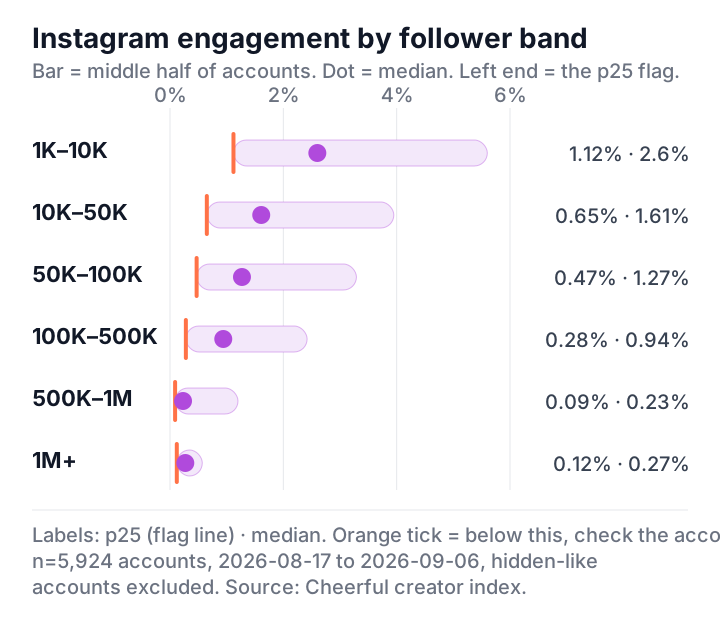
A worked example. A creator with 18,400 followers averages 250 likes and 36 comments a post: (250 + 36) ÷ 18,400 = 1.55%, just under the 1.61% median for 10K–50K and well above its 0.65% p25. That passes. A 142,000-follower account averaging 240 likes and 30 comments is at 0.19%, under the 0.28% p25 for 100K–500K, so it gets checked: look for sudden follower jumps, comments from unrelated accounts, and an audience outside your market. The template’s Shortlist tab does this comparison for you, and the Instagram engagement rate calculator places any account in its band. The method behind the bands is on the engagement benchmarks page.
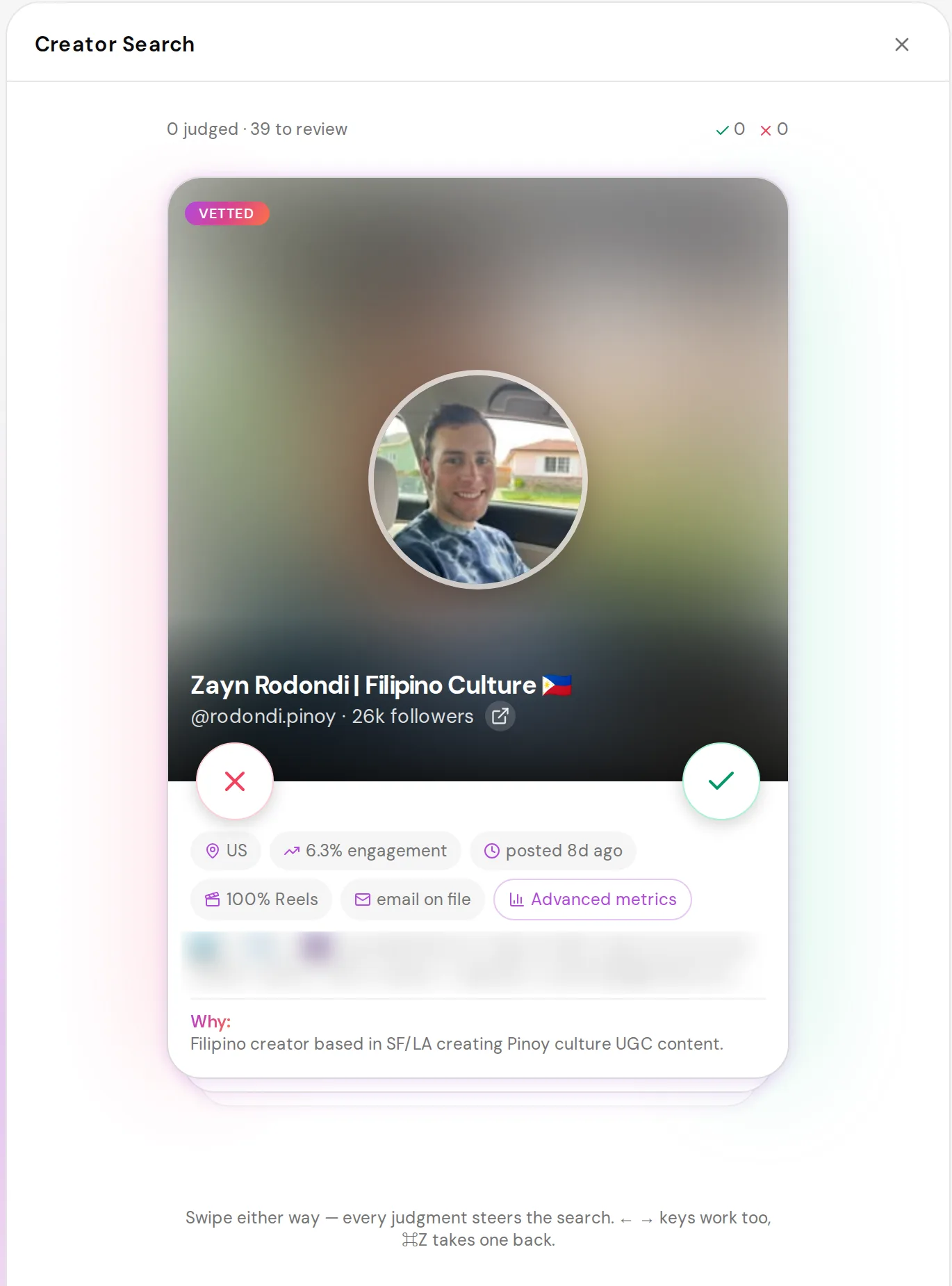
A discovery tool should show you this evidence rather than a score you cannot check. In Cheerful, each match arrives as a card with its engagement rate, follower count, how recently it posted and the reason it fits the brief, and you keep or pass it.
7. Reach out
Email beats DMs for anything with a fee or a shipping address, because it is where creators handle business and a thread keeps the terms in one place. Keep the first message short and specific: why them (name a post), what you are offering, what you would like in return, and one question they can answer in a line.
“Hi Maya, your Sunday meal-prep Reel with the sheet-pan salmon is exactly how our customers cook. We make [product] and would love to send you one, no strings. If you like it, we’d pay $300 for a Reel in October. Want me to send it over?”
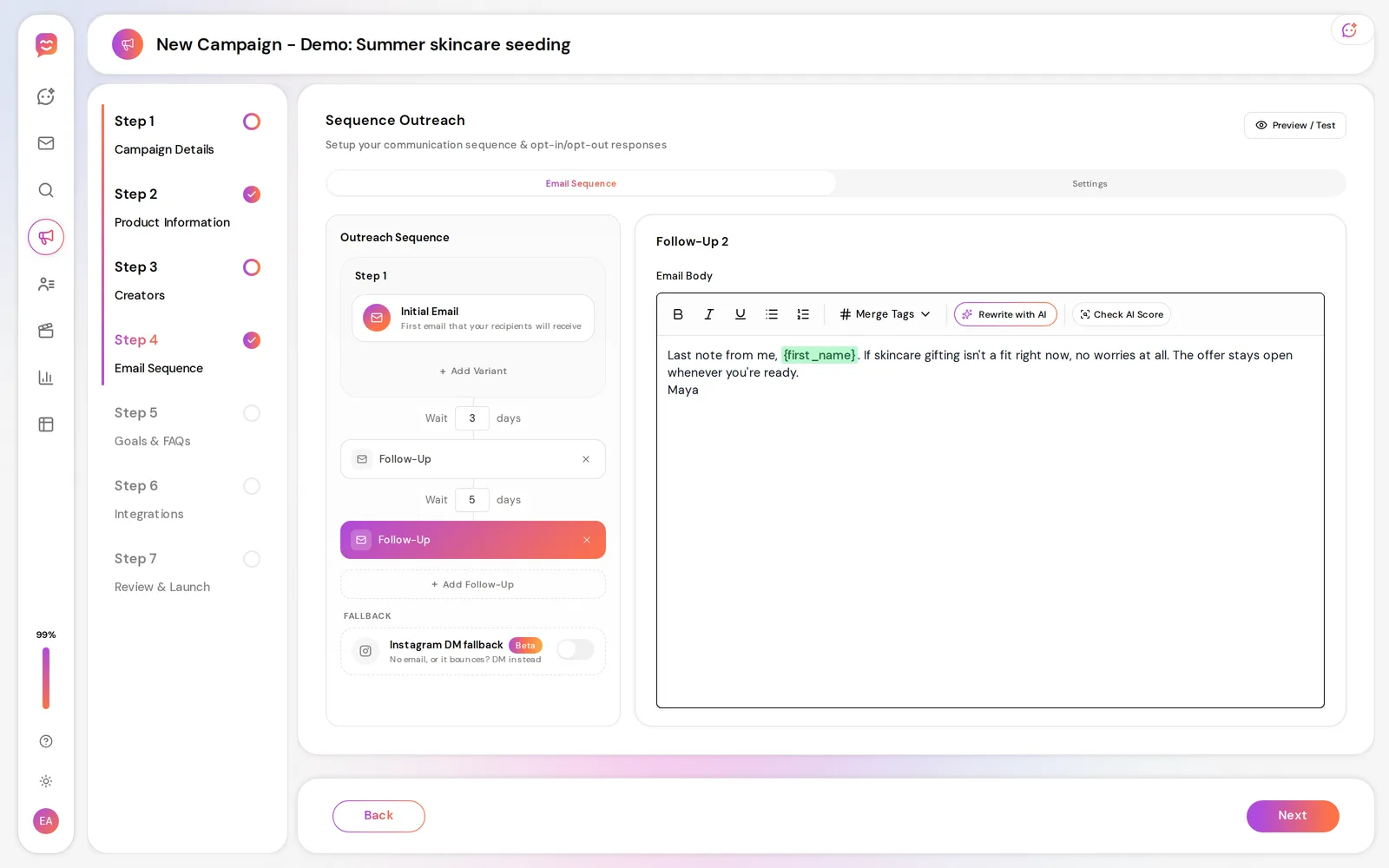
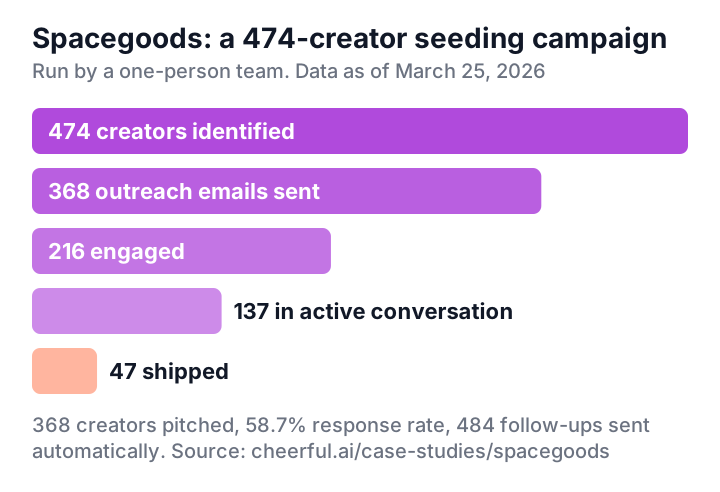
Many replies come after a follow-up, not the first message. Plan three follow-ups, three days apart, each shorter than the last, and stop the moment someone replies. Targeting matters more than wording: Spacegoods’ tightly matched wellness shortlist got a 58.7% response rate across 368 creators, while AG1’s affiliate recruiting at volume (20,521 creators contacted) got about 12% replies and still produced 2,030 opt-ins. What moves response rates, with the follow-up data, is in influencer outreach response rates, and ten copy-paste emails and DMs are in influencer outreach templates.
By hand, a shared inbox and the template’s Outreach log (it calculates the follow-up dates) work up to a few dozen threads. Beyond that, remembering which of 200 threads needs a nudge today is the job that gets dropped. Outreach tools automate the sequence. In Cheerful, the emails are personalised per creator and sent from your own Gmail, paced at about 30 a day for a new mailbox and 50 once it is established, and all pending follow-ups for a creator are cancelled the moment they reply.
8. Negotiate rates
Decide your ceiling per tier before the first reply arrives, and write it in the plan. The data says you can hold it: of 40 settled deals on Cheerful, 73% closed at exactly the brand’s best offer and 98% at or below it. Creators settled at a median of 0.66 of their opening ask, and a quarter of them at 40% or less. A high first ask is the start of a negotiation, not a no.
- 1Answer a rate with a number, not "that’s over budget". Name your figure and what it covers.
- 2Trade things that cost you little: extra product, a longer deadline, a commission on their code, or reposting their content with credit.
- 3Price usage rights, whitelisting and exclusivity as separate lines. They are one reason two creators of the same size quote very different prices.
- 4If the gap is still large, thank them and move on. The shortlist was three times the size you need for this reason.
This is the step where most tools stop. In Cheerful, when a creator names a rate, it shows that rate against what creators of similar size ask for the same format and drafts the counteroffer, accept and decline replies within the rules you set for the campaign; a person picks one and sends it. The full playbook is in how to negotiate rates with influencers.
9. Put it in writing
Every paid deal needs a written agreement, even a short one. It should cover the deliverables and dates, review rounds, the fee and payment terms, FTC disclosure, how long posts stay live, organic and paid usage rights, whitelisting, exclusivity, and termination. For gifting with no obligation to post, a one-paragraph acknowledgement is enough.
Our free influencer contract template has all three sizes (gifting acknowledgement, short-form, long-form) as a Word document, with a plain-English note on what each clause protects. To send it for signature from the same thread the deal was agreed in, Cheerful connects to SignWell, where creators sign on their collaboration page, and to DocuSign for teams that must use their own templates.
Phase 3: Run the campaign
10. Brief, gift and ship
A brief is one page. Longer briefs get skimmed, and over-scripted ones produce posts that read like ads and perform like them.
Then get the product there. By hand, that is copying each address from an email into your store as an order. It is fine for 20 parcels and error-prone at 200. In Cheerful, the address a creator gives in their reply is captured into a gift order drafted inside Cheerful; once a person approves it, it becomes a real $0 order in your Shopify store, tagged GIFTING-CHEERFUL so gift orders are easy to filter. More on running gifting at scale: product seeding, automating influencer gifting with Shopify and Cheerful for gifting.
11. Approve content, disclose, and amplify
Ask for a draft a few days before go-live, allow one or two rounds of changes, and limit your notes to facts, claims and the brief. Rewriting a creator’s voice is how you pay for a post their audience scrolls past.
Disclosure is not optional, and it is partly your responsibility. The FTC’s guidance for influencers says to disclose any "financial, employment, personal, or family relationship with a brand", including free product, to place it "with the endorsement message itself", and not to assume a platform’s disclosure tool is good enough on its own (FTC, Disclosures 101). Its guidance for brands says advertisers "need to have reasonable programs in place to train and monitor members of their network" (FTC Endorsement Guides FAQ). Put the wording in the brief and check each post when it goes live. Our FTC disclosure guide covers gifted and paid posts in detail.
Amplify the posts that already work. Instagram and Facebook Partnership Ads and TikTok Spark Ads let you run a creator’s post as an ad from their handle, so the ad looks like the post people already engaged with rather than a brand ad. This needs paid-usage rights in the contract and the creator’s authorisation inside the platform. The setup and pricing are in influencer whitelisting.
Phase 4: Measure and scale
12. Track results and decide who to re-book
Collect the numbers at 7 and 30 days after each post: views, likes, comments, shares and saves, link clicks, code orders and revenue. Then calculate the four numbers that compare creators fairly:
- CPM = total cost ÷ views × 1,000
- Cost per engagement = total cost ÷ (likes + comments + shares + saves)
- Cost per order = total cost ÷ orders on the creator’s code or link
- ROAS = revenue ÷ total cost
Total cost means fee plus product plus shipping, per creator. The template’s Tracker tab calculates all four per row, and the Report tab rolls them up. Then decide: re-book the creators in the top third on your primary KPI, drop the bottom third, and move the budget. Measurement in more depth, including what codes miss, is in influencer marketing ROI.
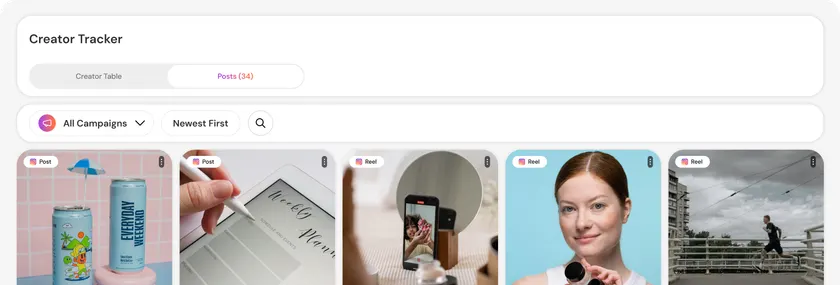
The hard part is knowing a post went up at all. Creators forget to send links, Stories expire in 24 hours, and gifted creators have no obligation to tell you. Checking every profile by hand works for a dozen creators. In Cheerful, posts are detected automatically and tied back to the creator and campaign, including from creators who never sent the link (how to know if an influencer actually posted).
When to move from a spreadsheet to a platform
A spreadsheet and your inbox are the right tools for a first campaign. They stop scaling at predictable points, and the first things to break are follow-ups and order entry, not discovery. These thresholds are our judgment from running campaigns, not a measured cut-off:
| Creators in flight | What works | What breaks first |
|---|---|---|
| Under 25 | The template, your inbox, your store admin | Nothing much. Stay here until it does. |
| 25 to 100 | Template plus an outreach tool for follow-ups | Follow-ups missed; addresses mistyped into orders; posts nobody noticed |
| 100 to 500, one or two people | A platform that runs outreach, replies, orders and tracking | Replies waiting a day; negotiation done inconsistently; the sheet is always out of date |
| 500+, or several brands | A platform, plus a CRM or data warehouse for reporting | Reporting across programs; permissions; spend control |
The 100-to-500 band run by one or two people is where Cheerful is built to sit: it runs discovery, outreach, replies, negotiation drafts, gifting orders and post tracking, with a person approving anything that moves money. Our comparison of the best influencer marketing platforms covers the others honestly, and influencer marketing for a one-person team covers the staffing side.
The influencer marketing plan template: what is in it
The template is a normal .xlsx file that opens in Excel, Google Sheets (File, then Import) or Numbers. There is no email gate. The example rows are labelled EXAMPLE so you can see the format and then delete them.
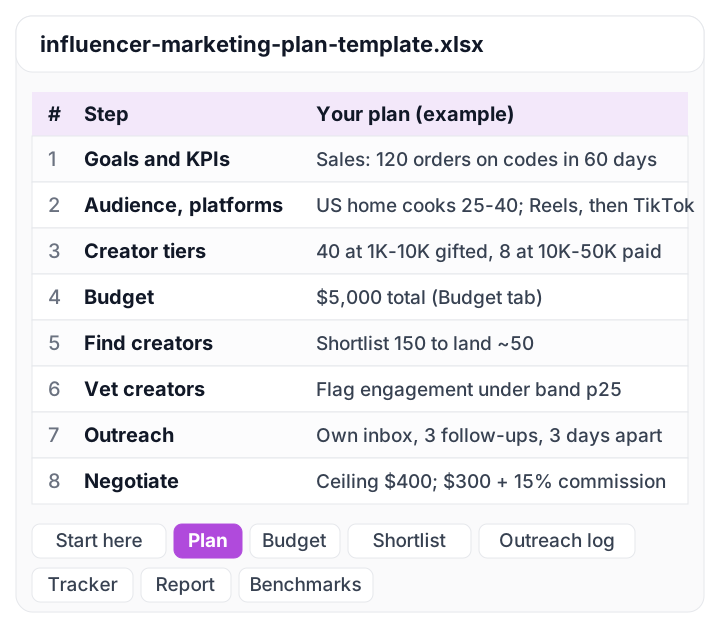
| Tab | What it does |
|---|---|
| Plan | The 12 steps, what to decide at each, an example answer, owner, due date and status |
| Budget | The two worked budgets from this guide plus your own column; totals and cost per creator calculate |
| Shortlist | Paste handles and numbers; price tier and the below-p25 engagement flag fill in |
| Outreach log | Follow-up dates 3 days apart that stop when you log a reply; ask ÷ offer per creator |
| Tracker | Contract, shipping, go-live, post URL, disclosure check and results; CPM, cost per engagement, cost per order and ROAS per row |
| Report | Totals and blended CPM, cost per order and ROAS, calculated from the Tracker |
| Benchmarks | Our engagement bands and rate medians, each with its sample size and date |
A worked example: Spacegoods, 474 creators in three weeks
Spacegoods, a UK wellness brand, ran a product-seeding campaign for its Rainbow Dust blend with a one-person influencer team. The manual version had been quoted at about $12,000 and three months of one person’s time; it ran in three weeks for roughly $1,000 on Cheerful (case study). Here is how it maps onto the plan.
| Step | What Spacegoods did |
|---|---|
| 1–3. Goal, audience, tier | Seeding at scale to wellness, fitness and lifestyle creators, 400+ targeted |
| 4. Budget | Product plus about $1,000 of platform cost, against a $12,000 manual quote |
| 5–6. Find and vet | 474 creators identified |
| 7. Reach out | 368 personalised emails in 5 batches in the brand’s own casual voice; up to 3 follow-ups, 3 days apart (484 sent automatically); 58.7% response rate |
| 8–9. Terms and details | Addresses, phone numbers and code preferences collected in the conversation, in the creator’s language |
| 10. Gift and ship | 89 discount codes created in GoAffPro; orders drafted when a creator confirmed shipping; 47 shipped by March 25, with 137 still in conversation |
| 12. Track | Instagram posts detected automatically, with their metrics |
Two lessons carry over to any program. The response rate came from targeting and a real offer, not from clever copy. And the funnel narrows at every stage (474 found, 47 shipped at the time of the snapshot), which is why the plan starts with a shortlist several times the size you need.
Common influencer marketing mistakes
- No KPI written before launch, so every result can be called a success.
- Choosing creators by follower count instead of audience fit and engagement for their band.
- Sending one email and no follow-ups, then concluding "influencers don’t reply".
- Paying the first ask. The median first ask in our data is twice what brands end up paying.
- No contract for paid work, then a dispute over usage rights when a post performs.
- Counting only code sales, which undercounts, then cutting a channel that was working.
- Running a gifting program with no way to know who posted.
And one case for not doing it yet: if you cannot ship to where creators’ audiences live, have no margin for free product, or have a product people need a demo to understand, fix that first. Creators amplify a product that already sells; they rarely rescue one that does not.
Frequently asked questions
- What is an influencer marketing strategy?
- An influencer marketing strategy is a plan for using creators to reach a measurable goal: who you work with, how many, what they are paid, what they publish, and which number decides whether you do it again. In practice it is 12 steps: goals and KPIs, audience and platforms, creator tiers, budget, finding, vetting, outreach, negotiation, contracts, briefing and shipping, approval and disclosure, and tracking.
- What is the best strategy for influencer marketing?
- For most brands starting out: many nano and micro creators (1K to 50K followers) chosen for audience fit, a gifting or low-fee offer, three follow-ups per creator, a unique code and link per creator, and a review at 30 days that re-books the top third. In our data, engagement is highest in the smallest bands (2.6% median at 1K to 10K followers on Instagram) and prices are lowest.
- What is the 3-3-3 rule for marketing?
- There is no single agreed definition; the name gets attached to several rules of thumb about grabbing attention quickly and repeating a short message. A version that is useful for influencer programs: test three creators in each of three tiers, give each campaign three weeks before judging it, and follow up three times before writing a creator off.
- What is the 5-3-2 rule on Instagram marketing?
- It is a content-mix rule: out of every 10 posts, 5 are content from others, 3 are your own content, and 2 are personal or behind-the-scenes posts. Creator content is the natural way to fill the "from others" share, as long as your agreement grants you organic usage rights to repost it with credit.
- What are the four R’s of influencer marketing?
- The common three are relevance (does the creator fit your audience), reach (how many people see the content) and resonance (does the audience act on it). Versions with a fourth R usually add relationship, meaning long-term partnerships beat one-off posts. Resonance is the one to measure, through engagement for the band and orders on the creator’s code.
- What is the 70/20/10 rule in marketing?
- It splits a budget into 70% on what is proven, 20% on promising extensions and 10% on experiments. Applied to creators: 70% to creators and formats that already hit your KPI, 20% to new creators in the tier that works, and 10% to a new platform, tier or format.
- What is KPI in influencer marketing?
- A KPI (key performance indicator) is the one number that says whether a campaign met its goal. Common ones: views and CPM for awareness, engagement rate and cost per engagement for engagement, and orders, cost per order and ROAS for sales. Write it with a target and a date, such as 120 orders on creator codes within 60 days.
- How much does an influencer marketing campaign cost?
- It depends on the tier mix. In real negotiations on Cheerful (measured 16 September 2026), the median brand offer per deal was $150 for 1K to 10K followers, $200 for 10K to 50K, $650 for 50K to 250K and $3,000 for 250K+, while creators asked a median $450, $500, $1,500 and $4,250. In this guide’s worked example, a 48-creator program (8 paid, 40 gifted) comes to $5,000 including product, shipping and a reserve.
- What are the key trends in influencer marketing for 2026?
- Three that show up in our own data and research: programs built on many small creators rather than a few large ones; brands proposing commission or hybrid pay while creators still quote flat fees (74% of priced lines in our data); and AI answers sitting on top of search results: Google showed an AI Overview on 851 of the 930 brand-side influencer marketing searches we checked in September 2026 (91.5%).
- Do I need an influencer marketing platform?
- Not for a first campaign. A spreadsheet, your inbox and your store admin handle up to about 25 creators at a time. Between 25 and 100, follow-ups and order entry start slipping. Past 100 creators run by one or two people, a platform that handles outreach, replies, orders and post tracking pays for itself in hours.