Influencer Outreach: How to Do It, Plus 10 Templates That Get Replies
·18 min read·By Abubakr Chan
Influencer outreach is contacting creators to propose a collaboration: a gifted product, a paid post, an affiliate deal or content you license for ads. The version that gets replies is short (under 150 words), names one specific thing the creator made, states a concrete offer, ends on one yes-or-no question, and is followed up up to three times, three days apart, stopping the moment they reply.
Below is the five-step process, when to email and when to DM, ten copy-paste templates for the common goals, and the reply rates we have actually measured: 58.7% on a 368-creator gifting campaign and about 12% on a 20,521-creator affiliate recruiting program. Disclosure: Cheerful is our product and both campaigns ran on it. The templates work from any inbox.
What is influencer outreach?
Influencer outreach (or influencer marketing outreach) is the first-contact stage of an influencer program: finding the creators who fit, getting a message in front of them, and turning a reply into an agreed deal. It is closer to sales prospecting than to PR. You are asking a small business owner, which is what a working creator is, to give your product space in front of an audience they have spent years earning.
That framing explains most of the advice below. Creators get a lot of pitches, and a pitch that could have been sent to anyone reads as one. The outreach that works makes it obvious in the first line that you watched their content, and makes it cheap to say yes in the last line. Everything in between is the offer. In a full influencer marketing strategy it sits between finding influencers and negotiating rates.
How to do influencer outreach in 5 steps
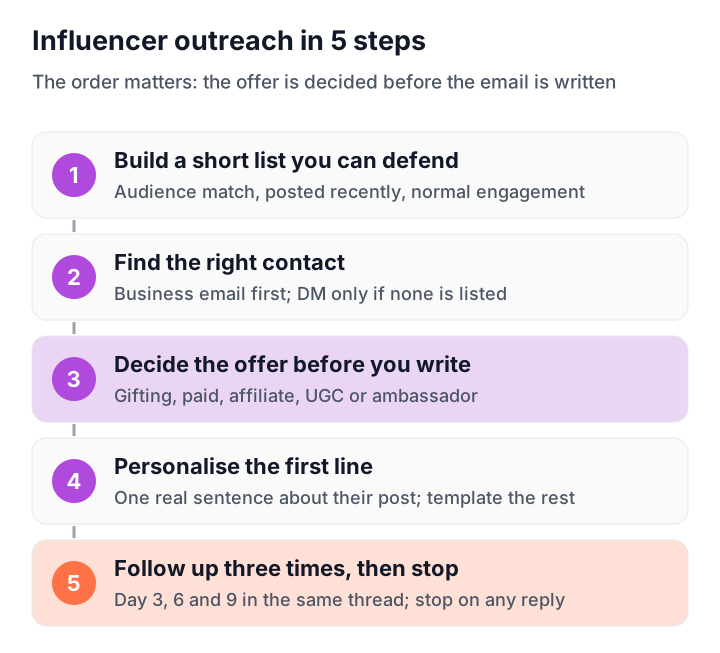
1. Build a short list you can defend
Every name on the list should pass three checks: their audience is plausibly your customer, they have posted in the last few weeks, and their engagement is normal for their size. A creator who posts once a month or whose likes collapsed last quarter will not answer, however good your email is. Our Instagram engagement benchmarks give the normal range per follower band, which is the fastest way to spot a padded account. For where the names come from, see how to find influencers, with its vetting checklist.
2. Find the right contact
Look for a business email before anything else: the Email button on an Instagram business or creator profile, the bio on TikTok, the channel’s About section on YouTube, or a link-in-bio page. If the address belongs to a manager or agency, expect a rate card rather than a chat, and treat it as a paid conversation from the start. No email anywhere is when a DM makes sense (next section).
3. Decide the offer before you write
The offer decides the template, the reply rate and the follow-up. Choose one per campaign and say it plainly in the first email. Vague offers ("we’d love to collab!") get vague replies or none.
| Offer | What you ask for | Works best for | What to expect |
|---|---|---|---|
| Gifting / PR | Nothing required; a post if they like it | Nano and micro creators, products with real retail value | Usually the easiest yes; posting is optional by definition |
| Paid post | A specific deliverable on a date | Any tier, when you need the content to happen | A rate card or counter; the first ask runs about 2x your budget |
| Affiliate / commission | Ongoing promotion with a link or code | Creators whose audience already buys in your category | Lower commitment, lower urgency |
| UGC only | Videos you run as ads; no posting | Paid social teams that need footage | Priced lower than posted content |
| Ambassador | Several months of deliverables | Creators who already posted for you and it worked | A negotiation over scope, term and exclusivity |
If the offer is paid, set your ceiling first. Across the negotiations we measured, a creator’s first ask was a median 2.0x the brand’s best offer (161 deals), and 73% of settled deals closed at exactly the brand’s highest stated number (40 deals). The number in your first email is, in practice, the deal. The tier-by-tier figures are in influencer rates 2026, and the rate calculator looks them up for one creator.
4. Personalise the first line, not the whole email
Write one sentence that could only have been sent to this person: name a specific post and a specific detail in it. Template the rest. A fully bespoke email per creator does not scale past a few dozen, and a fully templated one is recognisable by the second line. One real sentence is the trade that holds up. Write in the creator’s language if it is not yours: both campaigns in the reply-rate section below replied natively in German, French, Spanish and more.
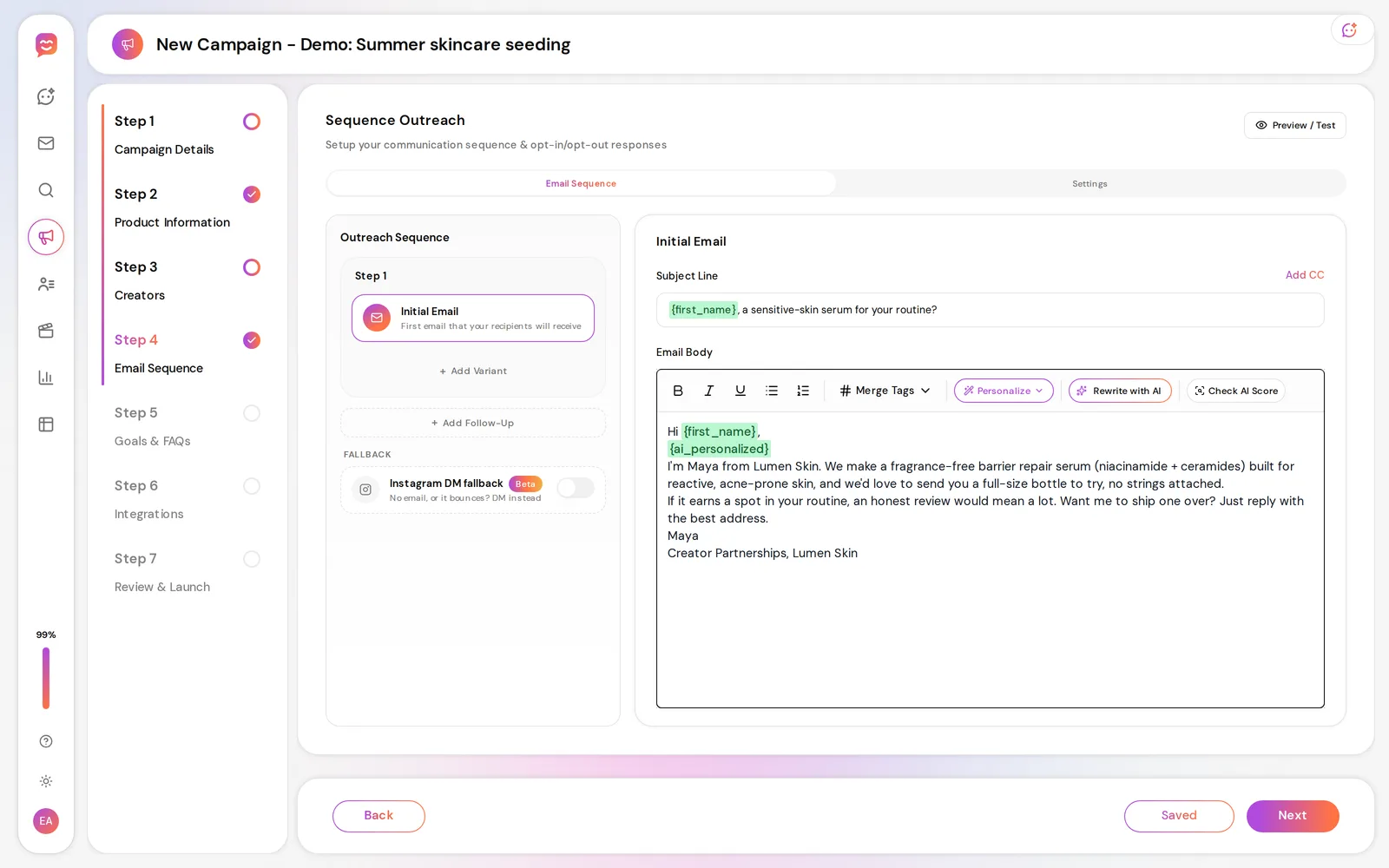
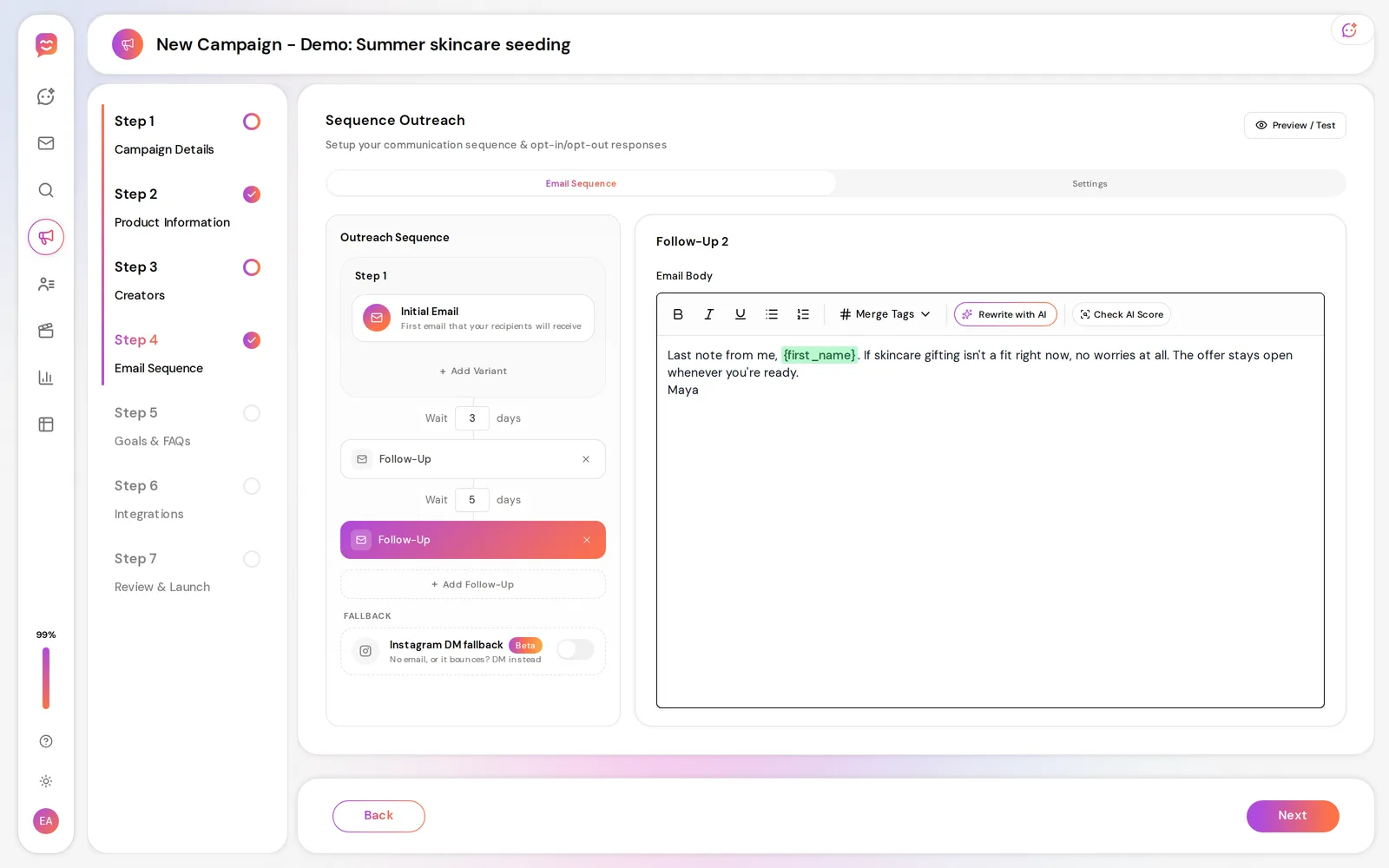
At volume this is the step a drafting tool earns its place. In Cheerful the personal line is a merge tag of its own: the opener is written for each creator from their recent posts, you approve the lines before anything sends, and a creator without an approved line gets a fallback sentence you wrote.
5. Follow up three times, then stop
Silence after one email usually means busy, not no. Send up to three follow-ups, three days apart, as replies in the same thread, each two or three sentences long. Stop the moment they reply, including when the reply is no. The full rules are in the cadence section below.
Should you DM or email influencers?
Email first whenever there is a business address. It is where creators handle brand deals, it holds the detail a deal needs, and a thread keeps the history in one place. DMs are for creators with no listed email, very small accounts who live in their inbox on the app, or a short warm-up before an email.
| Channel | Use it when | Watch out for |
|---|---|---|
| There is a business email; the offer has terms (fee, dates, usage) | Deliverability: send from a warmed, authenticated mailbox | |
| Instagram DM | No email listed; nano creators; a quick question before an email | Messages from accounts they do not follow land in Requests and are easy to miss |
| TikTok DM | The creator is TikTok-first and lists no email | Creators can restrict who may message them, so a DM may not be possible at all |
Whatever the channel, move the deal itself to email once they say yes. A DM thread is a poor place to agree a fee, a posting date and 30 days of usage rights.
10 influencer outreach templates (email and DM)
Each template has a subject line, when to use it, and why it works. Anything in [square brackets] is yours to fill in; the one you must not skip is the specific post in the first line. All ten are also in a plain-text file you can paste into Gmail, a mail-merge tool or your own sequences.
Download all 10 influencer outreach templatesPlain text / .txt · free, no email requiredEvery email and DM below with its subject line and placeholders, ready to paste.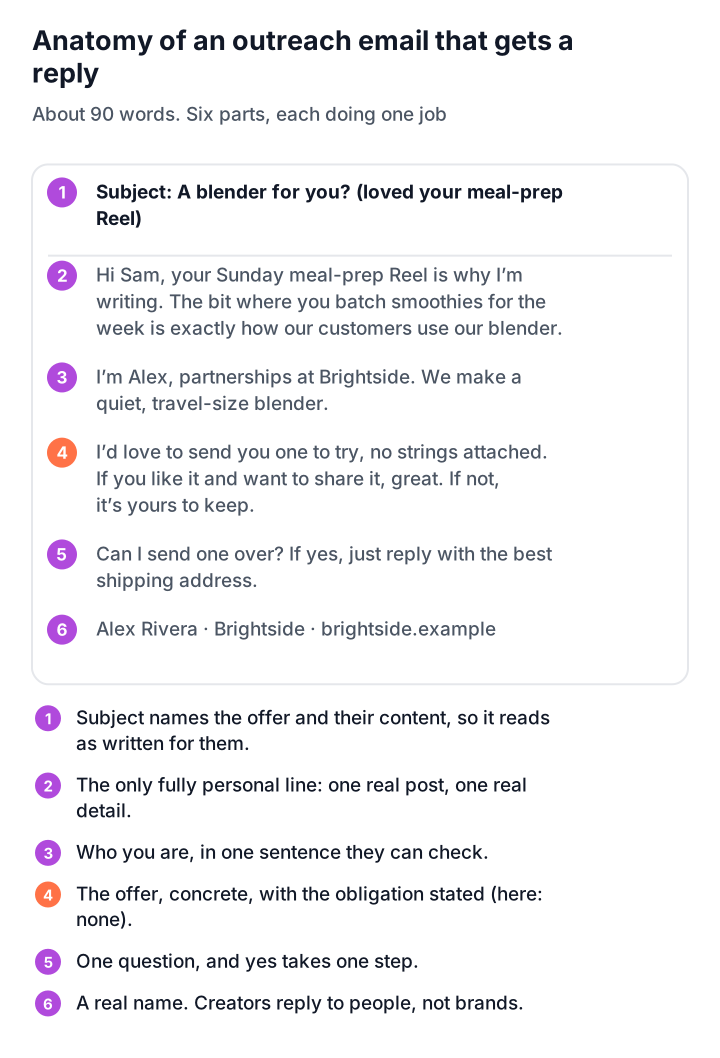
1. Gifting or PR email (free product, no obligation)
When to use: seeding a product to nano and micro creators, launch gifting, or any PR email where the product is the whole offer.
Subject: [Product] for you? (loved your [topic] post)
Hi [first name], Your [specific post, e.g. "5am training block" Reel] is why I’m writing. The bit where you [specific detail] is exactly how our customers use [product]. I’m [your name], [role] at [brand]. We make [one-line description]. I’d love to send you [product or bundle] to try, no strings attached. If you like it and want to share it, great. If not, it’s yours to keep. Can I send one over? If yes, just reply with the best shipping address. [Your name] [Brand] · [website]
Why it works: the offer is concrete and costs the creator nothing, and "reply with your address" turns yes into one step. Spacegoods ran this shape of email to 368 creators and 58.7% responded. Two cautions. "No strings" has to be true: if you require a post, it is a paid deal and should be written as one. And a gifted post still needs a disclosure, see FTC rules for gifted and sponsored posts. More note wording is in influencer gifting note examples.
2. Paid collaboration email
When to use: you need a specific deliverable, on a date, and you have a budget.
Subject: Paid collab: 1 Reel for [brand] in [month]
Hi [first name], Your [specific post] is the closest thing I’ve seen to how we’d want [product] shown: [specific detail]. I’m [your name] at [brand]. We’d like to pay you for one Instagram Reel in [month]: [one-line brief, e.g. "your normal morning routine with [product] in it"]. Our budget is $[amount] for the Reel, including 30 days of reposting on our account. Paid ad usage would be a separate line if you’re open to it. Does that work for you? If you have a rate card, send it over and I’ll tell you honestly what fits. [Your name] [Brand] · [website]
Why it works: it names the deliverable, the month and the money, so the creator can answer without a call. Stating your number is the counter-intuitive part. Since first asks run a median 2.0x the brand’s best offer and deals overwhelmingly settle at that offer, hiding the budget only adds a round of emails. Usage is itemised on purpose: in the rate cards we measured, usage and whitelisting are quoted as their own line, not folded into the fee.
3. Affiliate or commission email
When to use: recruiting creators into an affiliate program at volume.
Subject: [X]% commission + a free [product] for you
Hi [first name], Your [post about topic] stuck with me: [specific detail]. Your audience clearly trusts you on [category]. I’m [your name] at [brand]. We run an affiliate program for creators we’d actually use ourselves: [X]% on every sale through your link or code, a free [product] to start, and [payout terms, e.g. "monthly payouts"]. No posting quotas. Want me to set up your code? Reply "yes" and I’ll send your link and product today. [Your name] [Brand] · [website]
Why it works: commission alone is a weak opener because it pays nothing until it works, so the free product gives the creator a reason to try it now. At scale, expect a lower rate than gifting: AG1’s affiliate recruiting program contacted 20,521 creators, received about 2,460 replies (12%) and 2,030 opt-ins. Also expect to be the one proposing this model: only 2% of the priced lines creators sent in our rate data were commission or affiliate, against 74% flat fee.
4. UGC-only request (content, no posting)
When to use: you need footage for your own ads and do not need the creator’s audience.
Subject: Paid UGC: 3 short videos for [brand] ads
Hi [first name], Your [specific video] is the kind of footage we can’t make in-house: [specific detail, e.g. "straight to camera, natural light, no script feel"]. We’re looking for UGC rather than a post on your channel: 3 vertical videos, 15 to 30 seconds each, showing [product] in [use case]. We’d run them as ads on our own accounts for [usage term, e.g. 6 months]. Budget is $[amount] for the set, plus the product. Interested? I can send the brief first so you can judge the scope. [Your name] [Brand] · [website]
Why it works: "no posting" is said in the second paragraph, before the creator prices it as a post. The usage term is stated up front because it is what you are really buying. For budgeting, a UGC video with no posting had a median ask of $500 in our data (211 lines), against $1,800 for an Instagram Reel (586 lines).
5. Ambassador or long-term partnership email
When to use: a creator already posted for you and it performed. Not as a cold opener.
Subject: 6 months with [brand]? (after your [post])
Hi [first name], Your [post] about [product] did [specific, true result, e.g. "more for our site than anything else we ran that month"]. Thank you. Rather than one-off posts, we’d like to offer you a [6-month] ambassador role: [deliverables per month, e.g. one Reel and one story set], [compensation, e.g. $X a month plus Y% on your code], and first access to launches. We’d only ask for [category] exclusivity. Worth a 15-minute call next week to see if it fits how you work? [Your name] [Brand] · [website]
Why it works: it leads with evidence the creator can verify, which justifies asking for months instead of one post. It also scopes exclusivity narrowly, because a broad exclusivity clause is the most expensive thing on any rate card. This is the one template that asks for a call: the terms are too many for a single reply.
6. Instagram or TikTok DM opener
When to use: there is no business email anywhere, or the creator is small and clearly lives in their DMs.
Hi [first name]! Your [specific post] genuinely made me [reaction, e.g. rethink my morning routine]. I run creator partnerships at [brand] ([one-line what you make]) and I’d love to send you [product], no strings. What’s the best email for the details?
Why it works: under 50 words, a compliment that proves you watched, one clear offer, and a question that moves the conversation to email where the terms belong. Send it from the brand’s own account, not a personal one, so it is easy to check you are real.
7. Follow-up 1 (day 3)
When to use: three days after the first email, with no reply. Send it as a reply in the same thread.
Subject: Re: [original subject]
Hi [first name], just floating this back up in case it got buried. Still happy to send [product] your way. Worth a yes or no? [Your name]
Why it works: in the same thread, the original offer sits right underneath, so the follow-up does not need to repeat it. Asking for "a yes or no" gives permission to decline, which is easier to answer than a silent guilt trip. The second follow-up, on day 6, should add one new thing rather than repeat this one: a photo, what another creator made with the product, or a narrower ask.
8. Final follow-up (day 9)
When to use: the last message in the sequence. After this, stop.
Subject: Re: [original subject]
Hi [first name], I’ll stop filling your inbox after this one. If [product] isn’t a fit right now, no problem at all. If it’s just timing, reply "later" and I’ll check back in [month]. [Your name]
Why it works: it tells the creator the sequence is over and offers a one-word answer ("later") that keeps the door open without a commitment. Mark anyone who says "later" and actually write back in the month you named.
9. Negotiation reply (their rate is above your budget)
When to use: the creator sent a rate card or quote that is higher than you can pay.
Subject: Re: [original subject]
Hi [first name], Thanks for sending your rates. [Deliverable] at $[their ask] is above what we can do for this campaign; our budget is $[your number]. Two ways we could make it work: [option A, e.g. one Reel instead of a Reel plus stories] at $[your number], or [option B, e.g. the full package] at $[slightly higher number] if we drop paid usage to [30 days]. If neither works, I completely understand, and I’d love to keep you in mind for bigger launches. [Your name]
Why it works: it states one number, then trades scope instead of haggling on price. In our data, a creator’s counter lands at a median 1.19x the brand’s best offer (54 deals), so by the time you reach this email you are usually one small move from done. Usage and deliverable count are the cheapest things to move. More wording for this stage is in how to negotiate rates with influencers.
10. Declining gracefully
When to use: the creator replied but the fit or the price is not there, or a creator pitched you first.
Subject: Re: [original subject]
Hi [first name], Thanks so much for getting back to me and for sending your rates. We’re not able to go ahead this time: [honest reason in one clause, e.g. "our budget for this launch is set well below that"]. I’d genuinely like to stay in touch. Mind if I reach out when [next launch or bigger budget]? [Your name]
Why it works: a reply beats silence, because creators talk to each other and to managers who represent dozens of them. A one-clause reason that is about you (budget, timing, platform) rather than about them keeps the relationship usable for the next campaign.
How many follow-ups should you send?
Three, three days apart, and none after a reply. That is the cadence we run by default and the one Spacegoods used across 368 creators, which produced 484 follow-up emails without anyone writing them by hand. The rules that make it work:
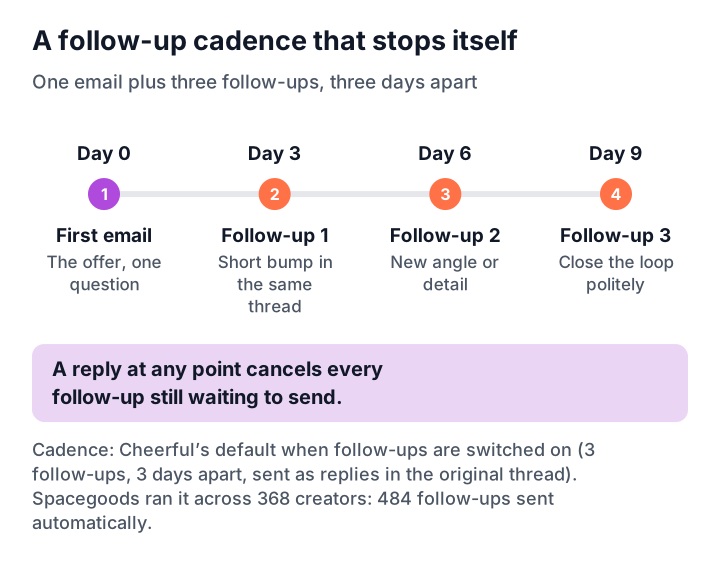
- Reply in the same thread. "Re:" keeps your first email in the thread under the follow-up and keeps the conversation in one place for both of you.
- Keep each follow-up to two or three sentences. The original offer is already in the thread underneath it.
- Add something new in the second follow-up. A repeat of the first reads as automated; one new detail reads as a person.
- Stop on any reply, including an out-of-office or a no. An automatic follow-up landing after "no thanks" is the fastest way to be remembered badly.
- Push the sequence back, do not restart it, when an auto-reply says they are away.
- Park, do not delete. Anyone who says "later" or never answers can be contacted for the next campaign with a new offer.
What reply rate should you expect from influencer outreach?
It depends on the offer and the list. The two programs we can publish sit far apart, and they differ on both at once: free product to a hand-picked list of 368, against an affiliate pitch to more than twenty thousand creators.
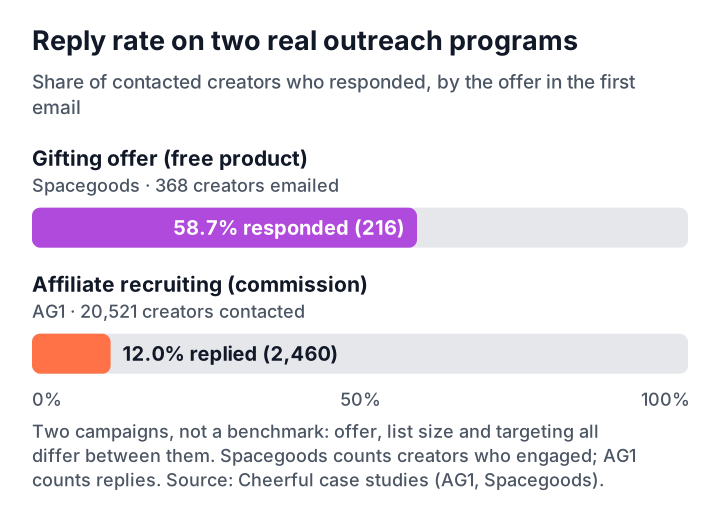
| Program | Offer | Creators contacted | Responded | Rate |
|---|---|---|---|---|
| Spacegoods | Gifting (product seeding) | 368 | 216 engaged | 58.7% |
| AG1 | Affiliate recruiting | 20,521 | ~2,460 replied, 2,030 opted in | ~12% replied, ~10% opted in |
Treat these as two data points, not a benchmark: the offer, the list size and the targeting all differ, and a small, tight gifting list will usually out-reply a broad recruiting list. If your first 50 emails get almost no replies, change the offer or the list before you touch the wording. The levers behind both numbers are broken down in influencer outreach response rates.
How do you ask an influencer to promote your product?
Ask for one specific thing, say what they get in return, and make the answer a single word. The wording that works has five parts, in this order:
- 1Lead with them: one sentence about a real post.
- 2Say who you are in one sentence, with a link they can check.
- 3Name the ask exactly: "one Reel in March", "try it and share if you like it", "three UGC videos, no posting".
- 4Name what they get: the product, the fee, the commission, the usage term.
- 5End on one question: "Can I send one over?" or "Does $600 work?"
What not to do: open with "collab?" and no details, ask for a free post in exchange for "exposure", or make gifting conditional on posting without paying for it. Whatever the deal, the post needs a clear disclosure, and asking for it in the brief saves an awkward edit later.
Deliverability: sending outreach from your own mailbox without burning it
Outreach should come from a named person on your own domain: creators reply to people, and replies to a no-reply relay get lost. The cost is that your mailbox’s reputation is on the line, so the pace matters more than the copy.
- Google’s hard caps are far above what outreach should use: 500 emails a day for a personal Gmail account and 2,000 a day per user on paid Google Workspace. Hitting either is a problem; approaching them with cold email is a bigger one.
- A safe outreach pace is tens a day per mailbox, not hundreds. Cheerful holds each connected mailbox to about 30 a day while it is new, rising over its first 14 days, and about 50 a day once established, with follow-ups counted in the same budget.
- Warm up a new mailbox. Start with a handful of sends a day and let normal two-way mail build before a campaign. A years-old address is already warm.
- Authenticate the domain. Google requires every sender to Gmail to set up SPF or DKIM, and senders of more than 5,000 messages a day to Gmail accounts also need DMARC and one-click unsubscribe, with the reported spam rate kept under 0.3%. Set up all three records regardless of volume.
- Keep it plain: plain text, no tracking pixels, no link shorteners, one link at most. Measure replies, not opens.
- More volume means more mailboxes, each with its own budget, not a faster pace from one.
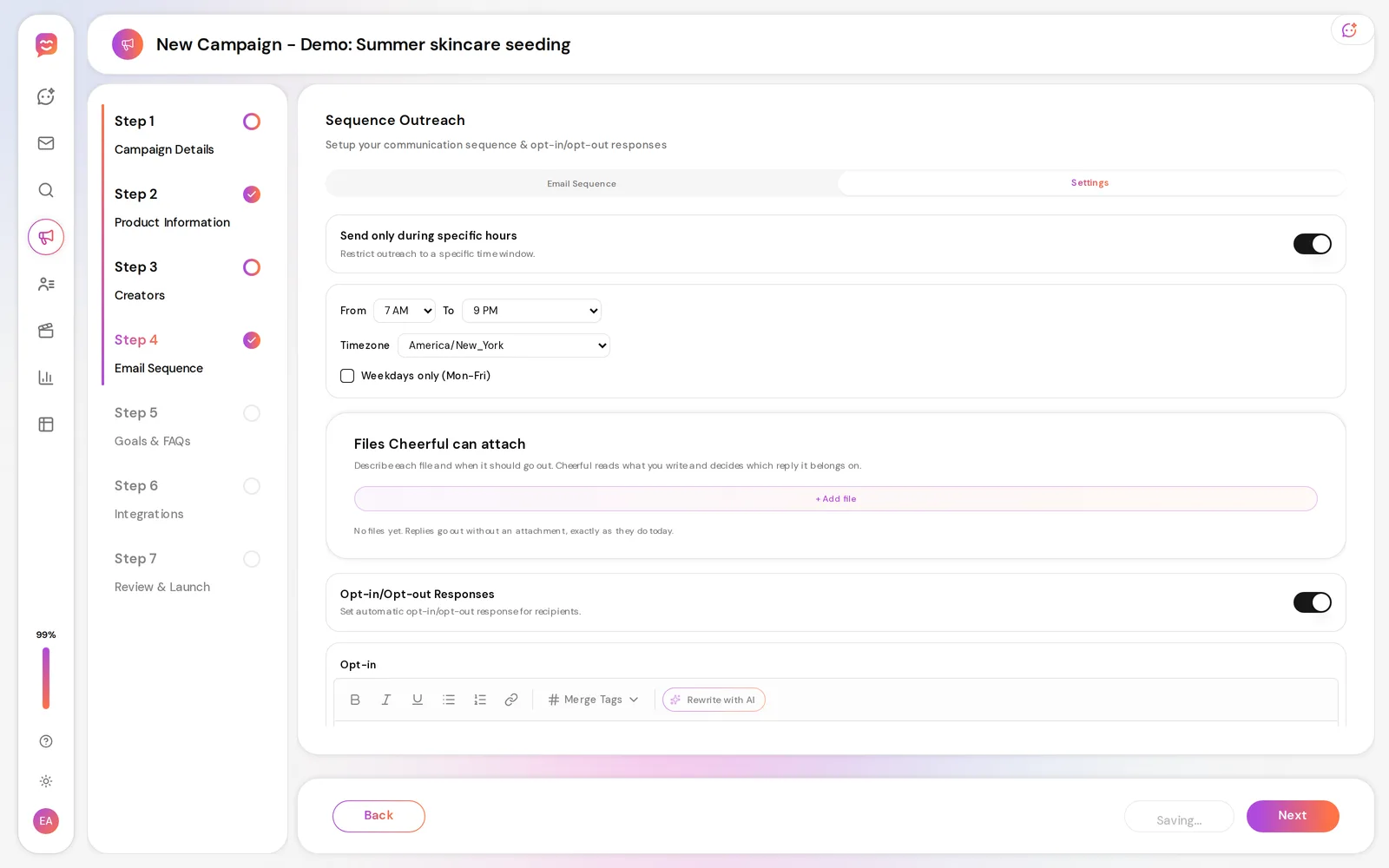
The detail on how we pace, send windows and Google permissions is in is it safe to send influencer outreach from Gmail?
Sending 200 of these without it reading like a template
Up to about 50 creators, Gmail and a spreadsheet is fine. Past that, three things break: writing a real first line per creator, remembering every follow-up, and answering replies quickly enough that interest does not cool. The tool options, honestly:
- Mail-merge add-ons for Gmail (GMass, YAMM). Merge fields and scheduled sends from your own inbox, and in some of them automatic follow-ups. The first line is still yours to write, and every reply and negotiation is still handled by hand.
- Outreach modules inside creator databases (Modash, Upfluence and similar). You send sequences to creators you found in the same tool. The rate conversation stays with you.
- An agent that runs the conversation. This is what we built Cheerful to do, so weigh it accordingly.
In Cheerful, the steps above map like this. It drafts a personalised first line for each creator from their recent posts, and you approve the lines before anything sends; a creator without an approved line gets the fallback sentence you wrote. Outreach goes out from your own Gmail at the paced 30-then-50-a-day budget. With follow-ups switched on, it sends up to three by default, three days apart, as replies in the original thread, and cancels all of them the moment the creator replies. Replies are sorted (opted in, opted out, has a question) and a response is drafted in the creator’s language, held for your approval by default. When a creator names a rate, the counteroffer is drafted for a human to approve, beside a rate card of what comparable creators ask. Replies to Instagram DMs are never sent automatically.
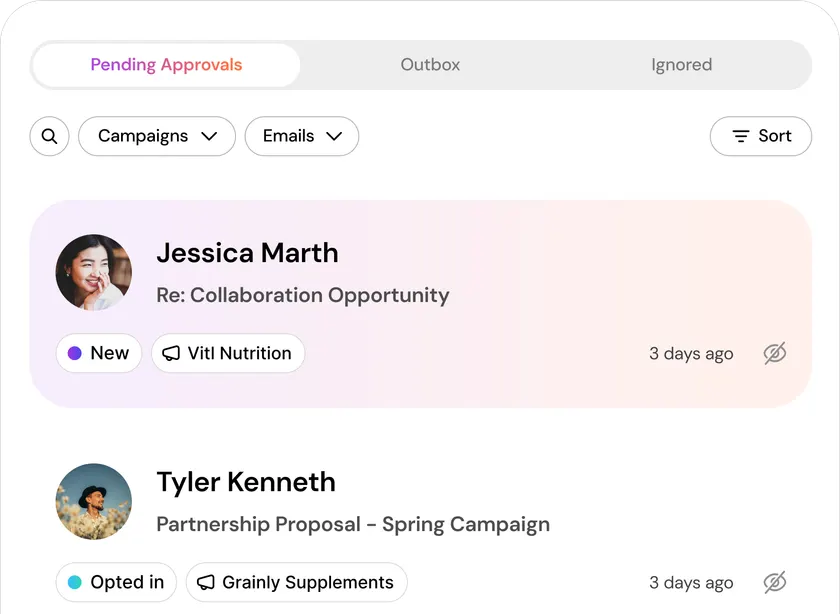
At AG1’s scale that meant 26,152 threads across 40 inboxes with an average reply time under a minute. The setup is in run influencer outreach from your own Gmail, the reply rules in how Cheerful handles creator replies, and the wider picture in AI that messages influencers for you.
Frequently asked questions
- What is influencer outreach?
- Influencer outreach is contacting social media creators to propose a collaboration, such as a gifted product, a paid post, an affiliate deal or UGC you license for ads. It covers choosing who to contact, finding their business email, writing the pitch, following up and turning a reply into agreed terms. Influencer marketing outreach means the same thing.
- How do you write a PR email for influencers?
- Name one specific post in the first line, say who you are in one sentence, offer the product with no obligation, and end with one question such as "Can I send one over?" Ask them to reply with a shipping address so yes is a single step. Keep it under about 150 words and follow up twice or three times, three days apart.
- Should you DM or email influencers?
- Email whenever the creator lists a business address, because that is where brand deals are handled and a thread holds the terms. Use a DM when there is no email or for very small creators, keep it under 50 words, and move to email once they say yes.
- How many follow-ups should you send to an influencer?
- Up to three, three days apart, as replies in the same thread, each shorter than the last. Stop as soon as they reply, including when the reply is no or an out-of-office.
- What subject line should an influencer outreach email use?
- A specific one that names the offer and, ideally, their content: "[Product] for you? (loved your [topic] post)" or "Paid collab: 1 Reel for [brand] in [month]". Avoid "Collaboration opportunity" on its own, which every pitch uses.
- What is a good response rate for influencer outreach?
- It depends mostly on the offer. On campaigns we can publish, a 368-creator gifting campaign (Spacegoods) reached 58.7%, and a 20,521-creator affiliate recruiting program (AG1) got about 12% replies and 2,030 opt-ins. If your first 50 emails get almost no replies, change the offer or the list before the wording.
- How do I email hundreds of influencers without doing it one by one?
- Personalise one sentence per creator and template the rest, send from several warmed mailboxes at tens of emails a day each, and automate the follow-ups so they stop on reply. Mail-merge add-ons handle the sending; an agent such as Cheerful also drafts the personalised first line and the replies for approval.
- What software automates influencer outreach for brands?
- Three kinds: Gmail mail-merge add-ons such as GMass or YAMM, outreach modules inside creator databases such as Modash or Upfluence, and agents that run the conversation. Cheerful, which is ours, sends from your own Gmail, runs follow-ups that cancel on reply, drafts replies in the creator’s language and drafts counteroffers for a human to approve.
- How many outreach emails can I send a day from Gmail?
- Google caps personal Gmail at 500 a day and paid Google Workspace at 2,000 per user, but cold outreach should stay far below that. Cheerful paces a new mailbox at about 30 a day rising over 14 days, and an established one at about 50, with follow-ups counted in the same budget.