An influencer contract is a written agreement between a brand and a creator that sets what the creator will publish, when, what they are paid, and what the brand may do with the content afterwards. Every paid influencer contract needs nine things: deliverables, review and approval, how long posts stay live, FTC disclosure, fee and payment terms, usage rights, exclusivity, termination, and independent-contractor status.
The free template below covers all nine, written from the brand’s side, in three sizes: a one-page gifting acknowledgement, a short-form agreement for a one-off paid post, and a long-form agreement with paid usage, whitelisting and an ambassador term. Every clause is printed in full on this page with a note on what it protects. It is not legal advice: it was written by a marketing team, not a law firm, so have a lawyer review it before you rely on it. Disclosure: Cheerful, which publishes it, is our product.
Influencer contract templateWord / Google Docs (.docx) · free, no email requiredAll three versions in one document: gifting acknowledgement, short-form and long-form agreement, with Schedule A. To use it in Google Docs, upload it to Drive and open it.What should an influencer contract include?
| Clause | What it settles | If it is missing |
|---|---|---|
| Deliverables | Platform, format, number of posts, dates, required tags and codes | You get a Story when you paid for a Reel |
| Review and approval | Draft deadline, number of revision rounds, response time | A post goes live with a claim you cannot make |
| Live period | How long each post stays up unedited | The post is archived a week later |
| FTC disclosure | Where and how the relationship is disclosed | A regulatory problem for both of you |
| Fee and payment | Amount, split, due date, invoicing, tax forms | A frequent dispute: when money moves |
| Usage rights | Where you may reuse the content, for how long, and whether ads are included | You cannot run the best post as an ad without a new deal |
| Exclusivity | Which competitors, for how long | A rival’s post in the same feed the same week |
| Termination | How either side exits and what is still paid | Arguments about money for work half done |
| Independent contractor | The creator is not your employee | Confusion over tax and control |
The template adds the clauses that keep those nine working: honest claims, music and third-party rights, performance reporting, a mutual conduct (morality) clause, confidentiality, indemnities, a liability cap and governing law. Schedule A puts the deal on one page, so neither side has to read 20 clauses to find the go-live date.
Which influencer contract template do you need?
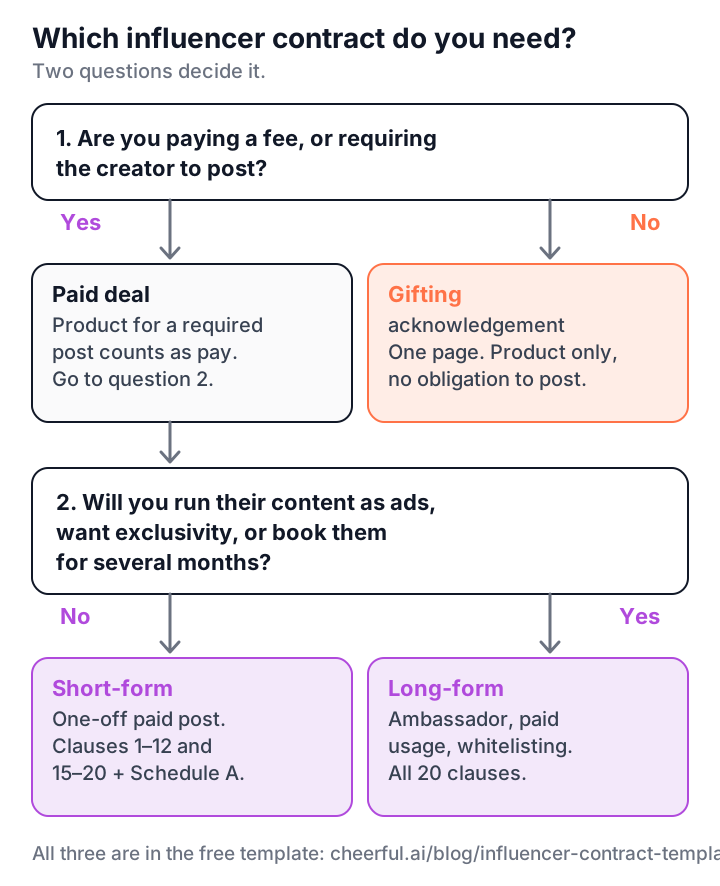
| Deal | Use | What is in it |
|---|---|---|
| Product sent, no fee, no obligation to post | Gifting acknowledgement | Five lines: it is a gift, disclose if you post, no health claims, we may reshare with credit, no ads without a new agreement |
| Product in exchange for a required post | Short-form agreement | Product counts as payment. Clauses 1 to 12 and 15 to 20, plus Schedule A |
| One-off paid post or small bundle | Short-form agreement | The same, with the fee in clause 6 |
| Running their posts as ads (whitelisting, Spark Ads, Partnership Ads) | Long-form agreement | Adds clause 13: paid usage, whitelisting access, ad spend and an end date |
| Ambassador or retainer over several months | Long-form agreement | Adds clause 14: monthly deliverables, monthly fee, 30-day exit, a month-3 review |
The line that matters is the obligation to post. Once a creator must post in return for something of value, product included, it is a paid deal and needs a real agreement. A pure gift does not, but the creator still has to disclose it if they post, and the acknowledgement says so.
The influencer contract template (full text)
This Influencer Marketing Agreement (the "Agreement") is entered into on [DATE] (the "Effective Date") between [BRAND LEGAL NAME], a [STATE / COUNTRY] [ENTITY TYPE] with its address at [ADDRESS] ("Brand"), and [CREATOR LEGAL NAME OR COMPANY], with its address at [ADDRESS] ("Creator"), who publishes content as [@HANDLE] on [PLATFORMS]. Brand and Creator are each a "Party". Brand wants Creator to create and publish content featuring [PRODUCT / BRAND] (the "Product"), and Creator wants to do so, on the terms below. The Parties agree as follows.
1. Deliverables
- 1.1 Creator will create and publish the content listed in Schedule A (the "Deliverables"), on the platforms, in the formats and by the dates stated there.
- 1.2 Each Deliverable must feature the Product as described in the creative brief Brand provides (the "Brief"). If the Brief and this Agreement conflict, this Agreement controls.
- 1.3 Creator will tag [@BRAND HANDLE] and use the link, discount code or hashtag listed in Schedule A in every Deliverable.
2. Content review and approval
- 2.1 Creator will send Brand a draft of each Deliverable (video file or link, caption and any on-screen text) at least [3] business days before its go-live date.
- 2.2 Brand may request changes up to [2] rounds per Deliverable. Change requests must be specific and consistent with the Brief. Brand will not unreasonably withhold approval.
- 2.3 If Brand does not respond within [2] business days of receiving a draft, the draft is treated as approved.
- 2.4 Creative control over voice, style and editing stays with Creator, provided the Deliverable meets the Brief, clause 4 and clause 5.
3. Publishing and how long content stays live
- 3.1 Creator will publish each approved Deliverable on the date in Schedule A, or another date both Parties agree in writing (email is enough).
- 3.2 Creator will keep each feed Deliverable public and unedited for at least [90] days after it goes live, and will not archive, hide or delete it in that period, except to fix a problem under clause 4.3 or clause 11.
- 3.3 Stories and other formats that expire on their own are exempt from clause 3.2. Creator will send Brand a screen recording or the insights for each Story before it expires.
4. FTC disclosure and platform rules
- 4.1 Creator will clearly disclose the relationship with Brand in every Deliverable, in the post itself and not only in a profile or bio. The disclosure must be easy to notice: at the start of the caption and, for video, said out loud or shown on screen. Acceptable wording includes "#ad", "Ad", "Sponsored" or "Paid partnership with [BRAND]". For gifted product, "Thanks to [BRAND] for the free product" or "#gifted" is acceptable.
- 4.2 Creator will also switch on the platform’s own branded-content or paid-partnership label where the platform offers one, in addition to (not instead of) the written disclosure.
- 4.3 If Brand tells Creator a Deliverable is missing a disclosure or does not meet this clause, Creator will fix it within [24] hours.
- 4.4 Both Parties will follow the US Federal Trade Commission’s Endorsement Guides (16 CFR Part 255), any similar rules where the content is shown, and the rules of each platform used.
5. Honest content and product claims
- 5.1 Creator will only share honest opinions and real experience of the Product, and will have used the Product before publishing.
- 5.2 Creator will not make claims about the Product beyond those in the Brief, and will make no health, medical, financial, earnings or before-and-after claims unless Brand has approved the exact wording in writing.
- 5.3 Brand is responsible for giving Creator accurate information about the Product and for any claim it asks Creator to make.
6. Fees, product and payment
- 6.1 Brand will pay Creator the fee in Schedule A (the "Fee") for the Deliverables. [OPTIONAL: Brand will also pay a commission of [X]% of net sales made with Creator’s code or link during [PERIOD], paid [monthly], net of refunds and cancellations.]
- 6.2 Brand will send Creator the Product listed in Schedule A at no cost. The Product is Creator’s to keep and is [in addition to / part of] the Fee.
- 6.3 Payment terms: [50]% of the Fee on signature and [50]% within [15 / 30] days after the last Deliverable goes live and Creator sends an invoice. [ALTERNATIVE: 100% within [30] days of invoice after the last Deliverable goes live.]
- 6.4 Creator is responsible for its own taxes. Creator will provide a completed tax form (for example IRS Form W-9 or W-8BEN) before the first payment.
- 6.5 Brand will not pay for expenses Creator incurs unless Brand approved them in writing in advance.
7. Ownership and organic usage rights
- 7.1 Creator owns the Deliverables and all copyright in them. Nothing in this Agreement transfers ownership to Brand unless Schedule A says the Deliverables are a work made for hire or assigned.
- 7.2 Creator grants Brand a non-exclusive, royalty-free licence to repost, share and embed the Deliverables, with credit to Creator, on Brand’s own organic social media accounts, website, email newsletters and [OTHER OWNED CHANNELS] for [12 MONTHS / THE TERM IN SCHEDULE A] from each go-live date (the "Organic Usage Period"), in [TERRITORY, e.g. worldwide].
- 7.3 This licence does not include paid advertising. Using a Deliverable, or Creator’s name, handle or likeness, in paid ads requires clause 13 or a separate written agreement.
- 7.4 Brand may keep archived copies after the Organic Usage Period ends, and does not have to delete posts it published during the period, but will not publish new ones.
8. Exclusivity
- 8.1 From the Effective Date until [30] days after the last Deliverable goes live (the "Exclusivity Period"), Creator will not publish sponsored or gifted content for these competing brands or product categories: [LIST NAMED COMPETITORS OR A NARROW CATEGORY, e.g. "powdered greens supplements"].
- 8.2 Exclusivity does not stop Creator from mentioning brands outside that list, or content Creator published before the Effective Date.
- 8.3 [IF NO EXCLUSIVITY: Delete clauses 8.1 and 8.2 and write "There is no exclusivity under this Agreement."]
9. Music, people and third-party rights
- 9.1 Creator will only use music, footage, fonts and other material that Creator has the right to use commercially, such as a platform’s commercial music library or licensed tracks. Trending sounds that are cleared only for personal use are not allowed in Deliverables.
- 9.2 Creator will get written permission from any identifiable person who appears in a Deliverable, and from a parent or guardian for anyone under 18.
10. Performance reporting
- 10.1 Creator will send Brand screenshots or an export of each Deliverable’s insights (reach or views, likes, comments, shares, saves, link clicks and, for Stories, taps and replies) at [7] and [30] days after it goes live.
- 10.2 Brand may use these figures internally and in reports to its own team, but will not publish them without Creator’s permission.
11. Conduct (morality clause)
- 11.1 If Creator publicly does or says something, during the term or the Organic Usage Period, that a reasonable person would see as seriously harmful to Brand’s reputation (for example hate speech, harassment, a criminal charge, or fraud), Brand may end this Agreement by written notice, stop using the Deliverables, and ask Creator to remove them.
- 11.2 In that case Brand will pay for Deliverables already published in compliance with this Agreement, and owes nothing further.
- 11.3 The same applies the other way round: if Brand becomes the subject of a public scandal that a reasonable person would see as seriously harmful to Creator’s reputation, Creator may end this Agreement, remove the Deliverables and keep the Fee for the work already done.
12. Term and termination
- 12.1 This Agreement starts on the Effective Date and ends when all Deliverables are published and all payments are made, except for the clauses that by their nature continue (7, 8, 13, 15, 16, 17, 18 and 19).
- 12.2 Either Party may end this Agreement if the other breaches it and does not fix the breach within [5] business days of written notice.
- 12.3 Brand may end this Agreement for convenience before the first Deliverable is published by giving written notice and paying a cancellation fee of [25]% of the Fee, plus the full Fee for any Deliverable already approved.
- 12.4 On termination, Brand pays for the Deliverables already published in compliance with this Agreement. Creator keeps the Product.
13. Paid usage and whitelisting (long-form only)
- 13.1 For the paid-usage fee in Schedule A, Creator grants Brand the right to use the Deliverables in paid advertising on [PLATFORMS, e.g. Meta and TikTok] for [60 / 90] days from [DATE / FIRST AD LAUNCH] (the "Paid Usage Period"), in [TERRITORY].
- 13.2 Whitelisting: during the Paid Usage Period Creator will give Brand advertising access to Creator’s account through the platform’s own partnership tools (for example Instagram and Facebook Partnership Ads or TikTok Spark Ads authorisation codes), so Brand can run the Deliverables as ads that appear from Creator’s handle. Creator will not have to share a password.
- 13.3 Brand pays all ad spend, and may only run the Deliverables as approved. Brand may shorten or crop a Deliverable and add a call-to-action button, but will not change its meaning, dub it, or write new captions in Creator’s voice without Creator’s approval.
- 13.4 Brand will moderate comments on the ads it runs and will not reply as Creator.
- 13.5 At the end of the Paid Usage Period Brand will stop all ads using the Deliverables within [3] business days. Creator may then revoke Brand’s access. Extending the Paid Usage Period requires a new written agreement and fee.
14. Ambassador term (long-form only)
- 14.1 Creator will act as a Brand ambassador from [START DATE] to [END DATE] (the "Ambassador Term"), and publish the monthly Deliverables in Schedule A in each month of it.
- 14.2 Brand will pay the monthly Fee in Schedule A within [15] days after each month’s Deliverables go live.
- 14.3 Either Party may end the Ambassador Term at the end of any month by giving [30] days’ written notice. Fees for published Deliverables are always paid.
- 14.4 The Parties will review performance at the end of month [3] and agree in writing whether to continue, change or end the arrangement.
15. Independent contractor
- 15.1 Creator is an independent contractor, not an employee, partner or agent of Brand. Creator decides how, when and where to make the content, within this Agreement.
- 15.2 Neither Party may sign contracts or make promises on behalf of the other.
16. Confidentiality
- 16.1 Until the relevant Deliverable is published, Creator will keep confidential any unreleased product, launch date, the Brief and the terms of this Agreement, including the Fee.
- 16.2 Brand will keep Creator’s personal information (address, phone number, tax and bank details) confidential and use it only to perform this Agreement.
17. Promises and indemnities
- 17.1 Each Party confirms it has the right to enter into this Agreement.
- 17.2 Creator confirms the Deliverables are original, do not infringe anyone’s rights, and follow clauses 4, 5 and 9. Creator will cover Brand’s reasonable costs from a third-party claim caused by Creator breaking those promises.
- 17.3 Brand confirms the Product and any information or claims it supplies are accurate and lawful. Brand will cover Creator’s reasonable costs from a third-party claim caused by the Product or by Brand’s instructions.
18. Limit on liability
- Except for the indemnities in clause 17 and any breach of clause 16, neither Party is liable for indirect or consequential losses, and each Party’s total liability under this Agreement is limited to the total Fee.
19. Law and disputes
- This Agreement is governed by the laws of [STATE / COUNTRY]. The Parties will first try to settle any dispute by good-faith discussion for [30] days. After that, disputes go to the courts of [COUNTY, STATE].
20. General
- 20.1 This Agreement, with Schedule A and the Brief, is the whole agreement between the Parties about this campaign. Changes must be in writing and agreed by both Parties; email counts.
- 20.2 Neither Party may transfer this Agreement to someone else without the other’s written consent, except to a buyer of Brand’s business.
- 20.3 This Agreement may be signed electronically and in counterparts, and each signed copy counts as an original.
Signatures
- BRAND: [BRAND LEGAL NAME]
- Signature: ____________________ Name: ____________________ Title: ____________________ Date: __________
- CREATOR: [CREATOR LEGAL NAME OR COMPANY]
- Signature: ____________________ Name: ____________________ Date: __________
Schedule A: campaign details
| Term | Fill in |
|---|---|
| Campaign | [CAMPAIGN NAME] |
| Deliverables | [e.g. 1 Instagram Reel (30–60 s) + 1 Story set of 3 frames] |
| Platforms and handle | [e.g. Instagram @handle] |
| Draft due | [DATE] (clause 2) |
| Go-live date | [DATE] (clause 3) |
| Must include | [Tag @brand, code CREATOR15, link in bio / sticker, key message] |
| Product | [PRODUCT, QUANTITY, RETAIL VALUE] |
| Fee | [$ AMOUNT] (clause 6) |
| Commission (optional) | [X% of net sales on code/link for PERIOD] or "None" |
| Payment terms | [50% on signature, 50% net-30 after last post] (clause 6) |
| Organic usage | [12 months, Brand’s owned channels, worldwide] (clause 7) |
| Paid usage / whitelisting | [None] or [90 days, Meta + TikTok, US, fee $ AMOUNT] (clause 13) |
| Exclusivity | [None] or [NARROW CATEGORY, 30 days after last post] (clause 8) |
| Minimum live period | [90 days] (clause 3) |
| Reporting | [Insights at 7 and 30 days] (clause 10) |
| Ownership | Creator owns the content; Brand has a licence (clause 7) |
Gifting Acknowledgement (no obligation to post)
Use this instead of the agreement when a creator receives product with no fee and no obligation to post. Paste it into your gifting email.
- 1[BRAND] is sending you [PRODUCT] as a gift. You don’t have to post about it, and there is no fee.
- 2If you do choose to post, please disclose that the product was gifted, in the post itself: for example "#gifted", "Gifted by [BRAND]" or "Thanks to [BRAND] for the free product". US law (the FTC Endorsement Guides) requires this whenever you receive something of value from a brand, even with no obligation to post.
- 3Please share your honest opinion, and don’t make health, medical or earnings claims about the product.
- 4If you post, we may reshare it with credit on [BRAND]’s own social accounts. We won’t use your content, name or likeness in paid ads without a separate written agreement.
- 5Please confirm your shipping address by replying to this email. Replying "Yes, I agree" confirms you’ve read this.
Usage rights, whitelisting and exclusivity: the clauses that change the price
Follower count explains less of a price than people assume. In our own backtest, predicting a creator’s real quote from the median of similar-sized creators landed within 2x of it only 37% to 75% of the time, depending on the segment; the rest of the spread comes from niche and from terms like these three. In real brand and creator threads on Cheerful, 940 of 12,076 priced lines named paid usage. We tried to measure a single "usage premium" from them and could not, because a line naming paid usage is usually the add-on priced on its own row, not the post with usage included. The practical reading: expect usage, whitelisting and exclusivity to be quoted separately, and scope them before you ask for a price.
| Deliverable (creator’s ask) | Median | Middle half | Quotes |
|---|---|---|---|
| Instagram Reel | $1,800 | $500–$3,900 | 586 |
| TikTok video | $2,000 | $500–$3,500 | 332 |
| Story set | $1,000 | $400–$2,500 | 287 |
| UGC video (no posting) | $500 | $282–$1,600 | 211 |
| Video integration (in a longer video) | $3,000 | $1,500–$5,800 | 161 |
Those are asks for the deliverable alone, measured 16 September 2026 with usage, whitelisting, exclusivity and boosting lines excluded. The full tables and method are in influencer rates 2026. Three rules that keep the add-ons affordable:
- Organic reposting on your own channels (clause 7) is the cheap right and often included. Ask for it by default.
- Paid usage and whitelisting (clause 13) are the expensive ones. Name the platforms, the territory and a fixed period (60 or 90 days), and buy an extension later if the ad is working rather than buying "perpetual" up front.
- Exclusivity (clause 8) is priced by how much work it stops the creator taking. Name competitors or one narrow category, start it on signature and end it 30 days after the last post.
For how whitelisting works on each platform and what to pay for it, see influencer whitelisting. For deals where part of the fee is commission, see performance-based influencer deals.
The FTC disclosure clause: what to require
Clause 4 is the one with a regulator behind it. The FTC’s guidance for creators says to disclose "when you have any financial, employment, personal, or family relationship with a brand", that free or discounted products count, and that the disclosure "should be placed with the endorsement message itself", not only on a profile page. It also says not to assume a platform’s disclosure tool is good enough on its own (FTC, Disclosures 101 for Social Media Influencers).
The brand side is spelled out too: "Advertisers need to have reasonable programs in place to train and monitor members of their network", and a brand may be liable for "hiring and directing endorsers who fail to make necessary disclosures" (FTC’s Endorsement Guides: What People Are Asking). That is why the template requires both the written disclosure and the platform label, gives you a 24-hour fix window, and pairs with a check when each post goes live. Our FTC disclosure guide for gifted and sponsored posts has example wording for each format.
How to send and sign an influencer contract
- 1Agree the terms in the thread first: deliverables, fee, dates, usage, exclusivity. The contract should record a deal, not open a new negotiation.
- 2Fill Schedule A from that thread, then check the bracketed placeholders are all gone.
- 3Send it through an e-signature tool so both sides get a signed copy with a date on it. Clause 20 allows electronic signature.
- 4Do not ship product or pay a deposit before it is signed.
- 5Save the signed copy next to the creator’s record, not in someone’s downloads folder.
At a handful of creators, emailing a PDF and a free e-signature account is fine. At dozens, the slow part is copying each creator’s agreed terms into each contract. In Cheerful, the rate and terms are already in the email thread where the deal was agreed, and the contract goes out from that thread: through SignWell, Cheerful’s built-in e-signature integration, where the creator signs on their collaboration page and can request changes; or through DocuSign as a connected app, for legal teams that require their own DocuSign templates. Either way, you can check who has not signed before approving their gift order.
SAG-AFTRA influencer agreements: when they apply
The SAG-AFTRA Influencer Agreement is a union agreement a creator can sign for sponsored content made for brands that are not union signatories. According to law firm Davis+Gilbert’s summary, the creator signs it through their own company (an LLC or corporation), the creator’s company pays the pension and health contributions, there is no minimum rate, and it covers audio and video content the creator produces themselves for their own or the brand’s channels (Davis+Gilbert, 2021). For a non-union brand, it usually changes little on your side: your agreement with the creator still sets the deliverables and fee. If a creator mentions it, or your brand is already a union signatory, check the current terms on SAG-AFTRA’s influencer pages and with your lawyer.
Frequently asked questions
- What should an influencer contract include?
- At minimum: deliverables and dates, review and approval rounds, how long posts stay live, FTC disclosure, the fee and payment terms, usage rights (organic and paid), exclusivity, termination, and independent-contractor status. Longer deals add whitelisting access, an ambassador term, performance reporting and a morality clause.
- What is an influencer agreement?
- An influencer agreement is a contract between a brand and a creator for sponsored content. It records what the creator will publish and when, what they are paid, how the partnership is disclosed, and what the brand may do with the content afterwards. Influencer agreement and influencer contract mean the same thing.
- Can you provide an example of an influencer agreement?
- Yes. The full text of a brand-side influencer agreement is printed on this page, clause by clause, and can be downloaded as a Word document. It includes a one-page gifting acknowledgement, a short-form agreement for a single paid post, and long-form clauses for paid usage, whitelisting and ambassador deals.
- Do influencers have to disclose paid partnerships?
- Yes, in the US. The FTC says creators must disclose any financial, employment, personal or family relationship with a brand, including free or discounted products, in the post itself, and that a platform’s paid-partnership label may not be enough on its own. Brands are expected to train and monitor the creators they work with.
- Can influencers get sued?
- Yes. A brand can sue a creator for breaching a contract, for example by not posting after being paid or by using music they had no right to use, and third parties can bring claims over false product claims or copyright. The FTC also addresses creators directly about disclosure. A written agreement lowers the risk for both sides by making the obligations clear.
- Do I need a contract for influencer gifting?
- Not a full agreement if there is no fee and no obligation to post. A short gifting acknowledgement is enough: it says the product is a gift, asks the creator to disclose if they post, and says you will not use their content in ads without a separate agreement. Once you require a post in return, it is a paid deal and needs a contract.
- How long should influencer usage rights last?
- For reposting on your own channels, 12 months is a common default. For paid ads and whitelisting, a fixed 60 or 90 days is easier to price and to get signed, with an extension bought later if the ad performs. Avoid asking for perpetual rights bundled into a posting fee.
- Is this influencer contract template lawyer-approved?
- No. It was written by a marketing team from the brand side and has not been reviewed by a lawyer for any state or country. Use it as a starting point and have a qualified lawyer review it, especially for paid usage, exclusivity and multi-month deals.
- Where can I find influencer contract templates?
- This page has a free brand-side template in Word format with no sign-up, in three sizes. Legal-document sites sell customisable versions, and larger brands usually have their legal team adapt a standard services agreement. Whichever you start from, check it covers usage rights, whitelisting and FTC disclosure, which generic service contracts miss.